
Experimental investigation of yield and hysteresis behaviour of an epoxy resin under cyclic compression in the large deformation regime
Jingwei Yu, Christian Breite, Frederik Van Loock, Thomas Pardoen, Yentl Swolfs
Vol. 18., No.2., Pages 133-143, 2024
DOI: 10.3144/expresspolymlett.2024.11
DOI: 10.3144/expresspolymlett.2024.11
Corresponding author: Yentl Swolfs 
GRAPHICAL ABSTRACT
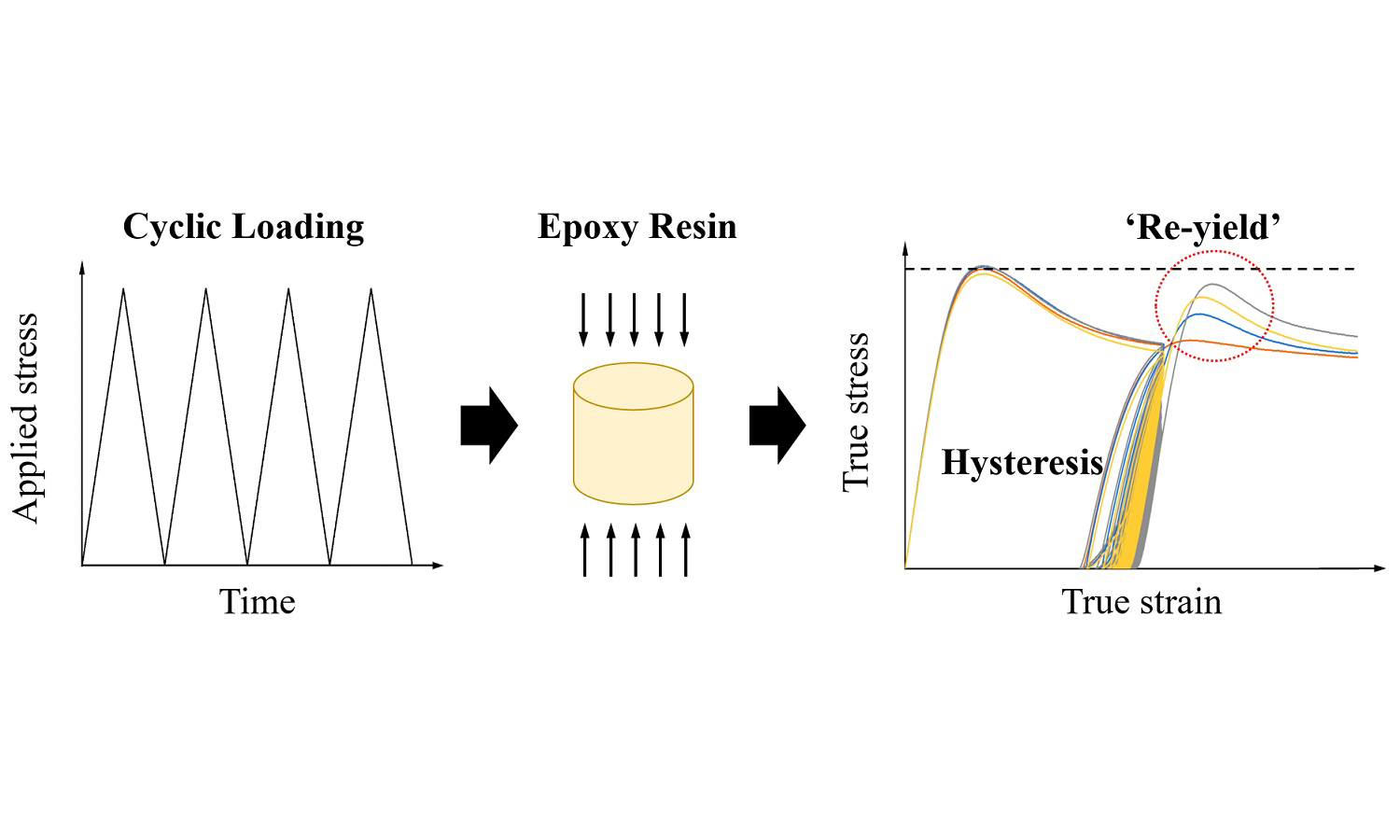
ABSTRACT
High-performance polymers are extensively used in various applications undergoing long-term cyclic loadings. The deformation behaviour of an amorphous thermoset epoxy resin undergoing cyclic compressive loading is investigated for a range of applied deformation levels. The measurements indicate significant hysteresis upon repeated loading and unloading cycles with progressive accumulation of plastic strain. Cyclic damage leads to a reduction of the stress needed to reach the peak strain per cycle, while cyclic stiffening corresponding to an increase of elastic modulus with increasing number of cycles is observed, attributed to chain orientation effects. The dissipated energy asymptotically decreases to zero under strain-controlled cycling conditions. Interestingly, when monotonically loaded after cycling, the epoxy exhibits an increase in yield strength. This ‘re-yield’ stress level is closely related to the selected value of the peak (unloading) strain level and increases with increasing number of loading cycles.
RELATED ARTICLES
Maciej Kisiel, Weronika Zając, Magdalena Włodarska, Łukasz Byczyński, Dominika Czachor-Jadacka, Beata Mossety-Leszczak, Gabriela Pietruszewska, Magda Droździel-Jurkiewicz, Jarosław Bieniaś
Vol. 18., No.5., Pages 516-532, 2024
DOI: 10.3144/expresspolymlett.2024.38
Vol. 18., No.5., Pages 516-532, 2024
DOI: 10.3144/expresspolymlett.2024.38
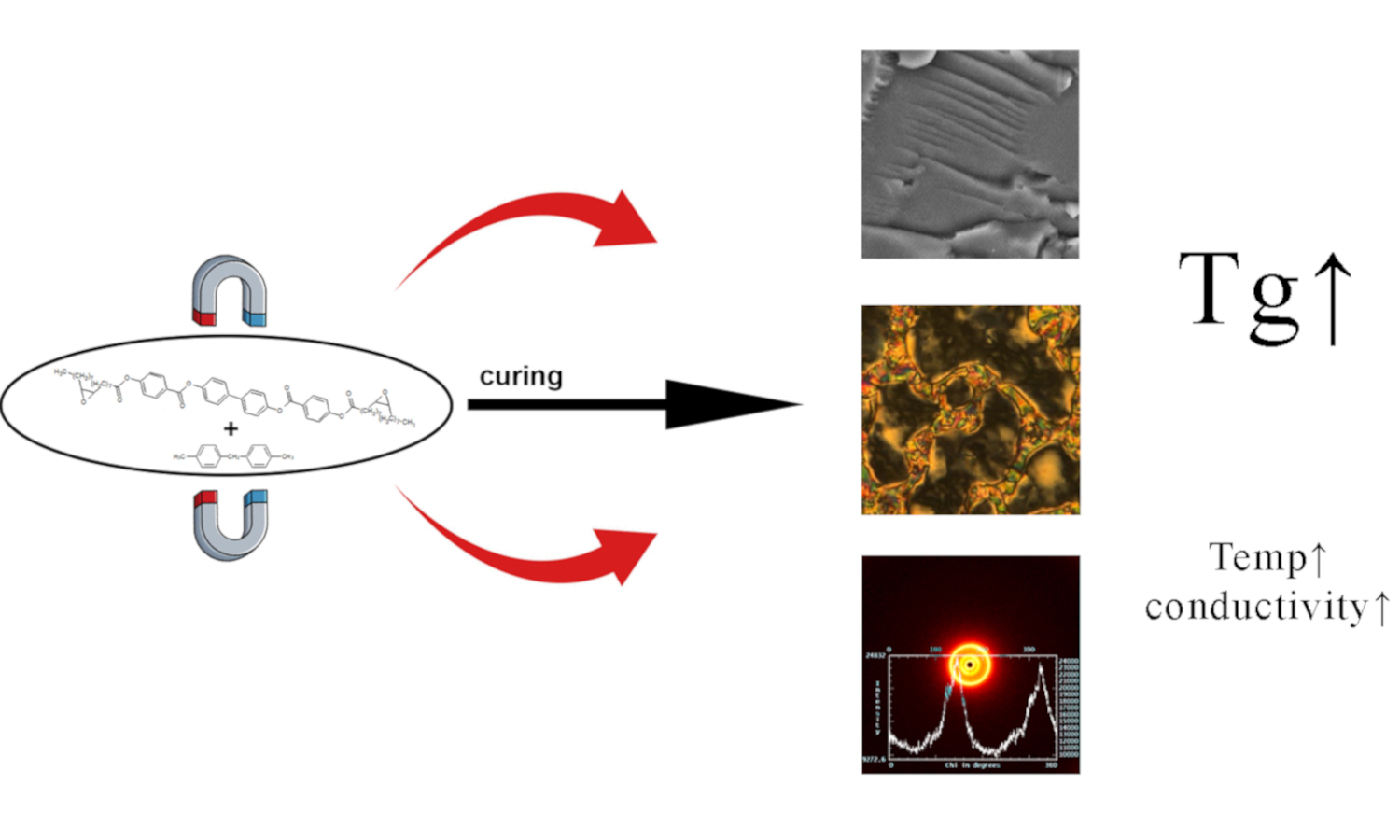
Novel nonterminal liquid crystalline epoxy resin has been synthesized, and its structure and nature have been determined via nuclear magnetic resonance (NMR) and polarized optical microscopy (POM). Then, it was cured with the use of 4,4′-diaminodiphenylmethane (4,4′-DDM). The curing process has been investigated via differential scanning calorimetry (DSC) and infrared spectroscopy (FTIR) methods. Polymerization has been conducted with (1.2 T) and without the presence of a strong magnetic field. The properties of the obtained polymers have been described using DSC, thermogravimetric analysis (TGA), scanning electron microscopy (SEM), dielectric spectroscopy (DS) and X-ray scattering studies (WAXS/SAXS). It has been proved that the magnetic field induces molecular ordering and increases the glass transition temperature (Tg) by over 20 °C. The obtained ordered polymers are thermally stable up to over 300 °C, undergo vitrification at slightly elevated temperature (37.5 °C), and their electrical conductivity rises significantly at the transition to an elastic state, which, among other possibilities, makes them a proper candidate for a smart, lightweight polymers with tuneable properties by a subtle temperature rise and possibility of tailoring its structure by a magnetic field.