In situ catalyzed poly(ε-caprolactone)/organic rectorite nanocomposites with excellent electrochemical performance
Limin You, Shifan Zhang, Zhuoxiong Huang, Wanle Pi, Jiaqi Liu, Rui Ma
Vol. 17., No.11., Pages 1154-1165, 2023
DOI: 10.3144/expresspolymlett.2023.87
DOI: 10.3144/expresspolymlett.2023.87
Corresponding author: Rui Ma 
GRAPHICAL ABSTRACT
ABSTRACT
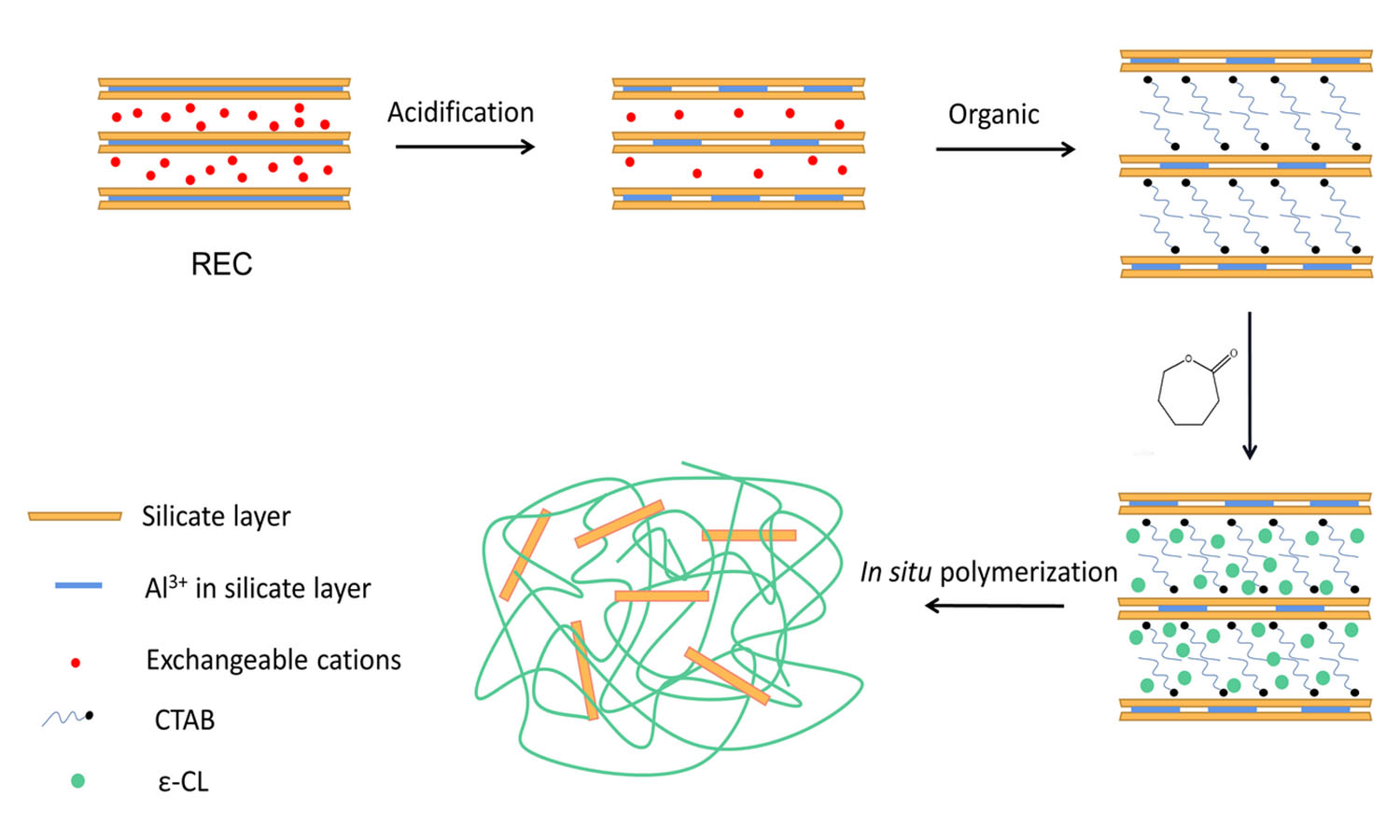
In recent years, solid polymer electrolytes (SPE) has attracted much attention because of its good safety and environmental stability, among which poly(ε-caprolactone) (PCL) based solid electrolyte film is one of the most potential materials. We have adopted the method of synthesizing polymer nanocomposites with natural clay, which can effectively meet the needs of electrolytes. In this study, cetyl trimethyl ammonium bromide (CTAB) was used to modify rectorite (REC), and the ε-CL monomer is inserted between the rectorite silicate layers. PCL/organic rectorite (OREC) nanocomposites were synthesized by in situ intercalation polymerization. The yield of the polymer nanocomposite could reach 93.6% when the molecular weight of the polymer nanocomposite was 39 000. The effects of OREC addition on the morphology, thermal stability, and electrochemical properties of PCL/OREC nanocomposites were investigated by various characterization methods. The temperature can be increased by 50 °C when the thermal decomposition is 50 wt%, and the crystallinity decreases by 4.6%. Composite polymerelectrolytes (CPEs) (PCL/OREC) showed a good electrical conductivity of 1.13·10–4 S·cm–1 at 60 °C and an excellent capacity retention rate of 96.7% after 100 cycles at 0.5 C current density. This study has important guiding significance for the development of polymer nanocomposites as solid electrolytes.
RELATED ARTICLES
Malgorzata Latos-Brozio, Aleksandra Drzazga, Anna Masek, Zdzisława Mrozińska, Marcin H. Kudzin
Vol. 20., No.7., Pages 742-760, 2026
DOI: 10.3144/expresspolymlett.2026.56
Vol. 20., No.7., Pages 742-760, 2026
DOI: 10.3144/expresspolymlett.2026.56
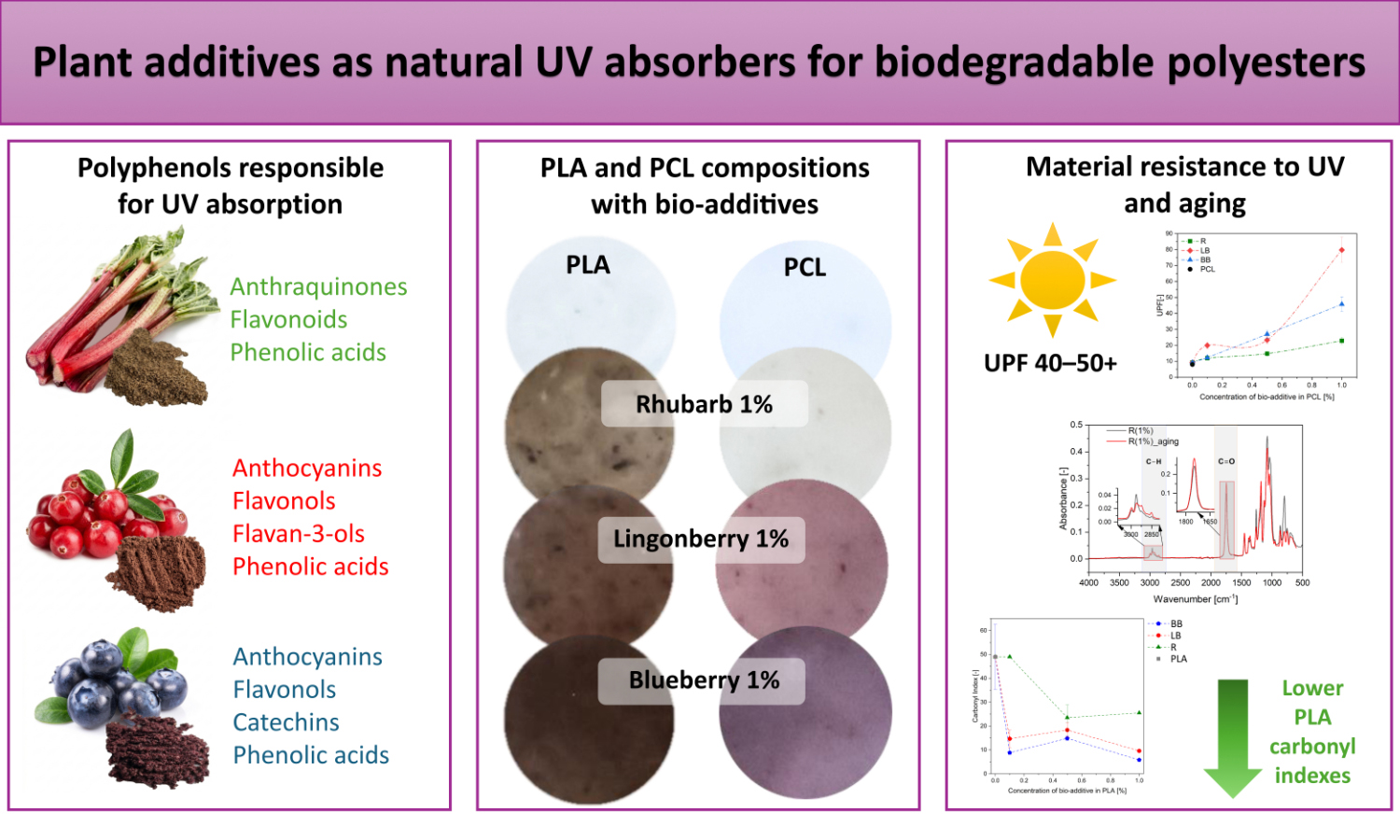
We investigated the effectiveness of plant-based bio-additives – rhubarb, lingonberry, and blueberry (0.1–1%) – as natural UV absorbers in biodegradable polymers polylactide (PLA) and polycaprolactone (PCL). A novelty of this work is the direct use of plant-based raw materials as UV absorbers in polymers. We performed Fourier transformed infrared spectroscopy (FT-IR) and UV-Vis analysis of the bio-additives, determined the ultraviolet protection factor (UPF) for the polymer samples, and evaluated their physicochemical properties (structural changes, colour, hardness, surface energy) after weathering (PLA) and thermo-oxidative (PCL) aging. Spectroscopic tests confirmed the presence of UV-A/UV-B-absorbing chromophores in the additives. Samples with 1% berries had excellent UV protection (UPF 40–50+), while PLA and PCL containing 1% rhubarb had lower UPF values (around 22), indicating good UV blocking properties. After aging, PLA-containing berries showed a significantly lower carbonyl index (CI), indicating reduced photodegradation. For PCL with lingonberry, this additive gave the greatest reduction in thermo-oxidative degradation (lowest CI). All plant additives increased material hardness by acting as nucleating agents; they increased the crystallinity of polyester, and aging further strengthened this effect. Bio-additives, especially berries, can increase the hardness and UV resistance of polymers and limit material aging. These polymer compositions are suitable for packaging materials.