
Electrically conductive polymer composites: Today’s most versatile materials?
Roland Petrény , Ádám Bezerédi, László Mészáros
, Ádám Bezerédi, László MészárosVol. 18., No.7., Pages 673-674, 2024
DOI: 10.3144/expresspolymlett.2024.49
DOI: 10.3144/expresspolymlett.2024.49
Corresponding author: László Mészáros 
GRAPHICAL ABSTRACT

RELATED ARTICLES
Kaituo Fang, Junxiu Xue, Yu Wang, Yongming Zhang, Gang Yan, Li Li
Vol. 20., No.7., Pages 687-697, 2026
DOI: 10.3144/expresspolymlett.2026.52
Vol. 20., No.7., Pages 687-697, 2026
DOI: 10.3144/expresspolymlett.2026.52
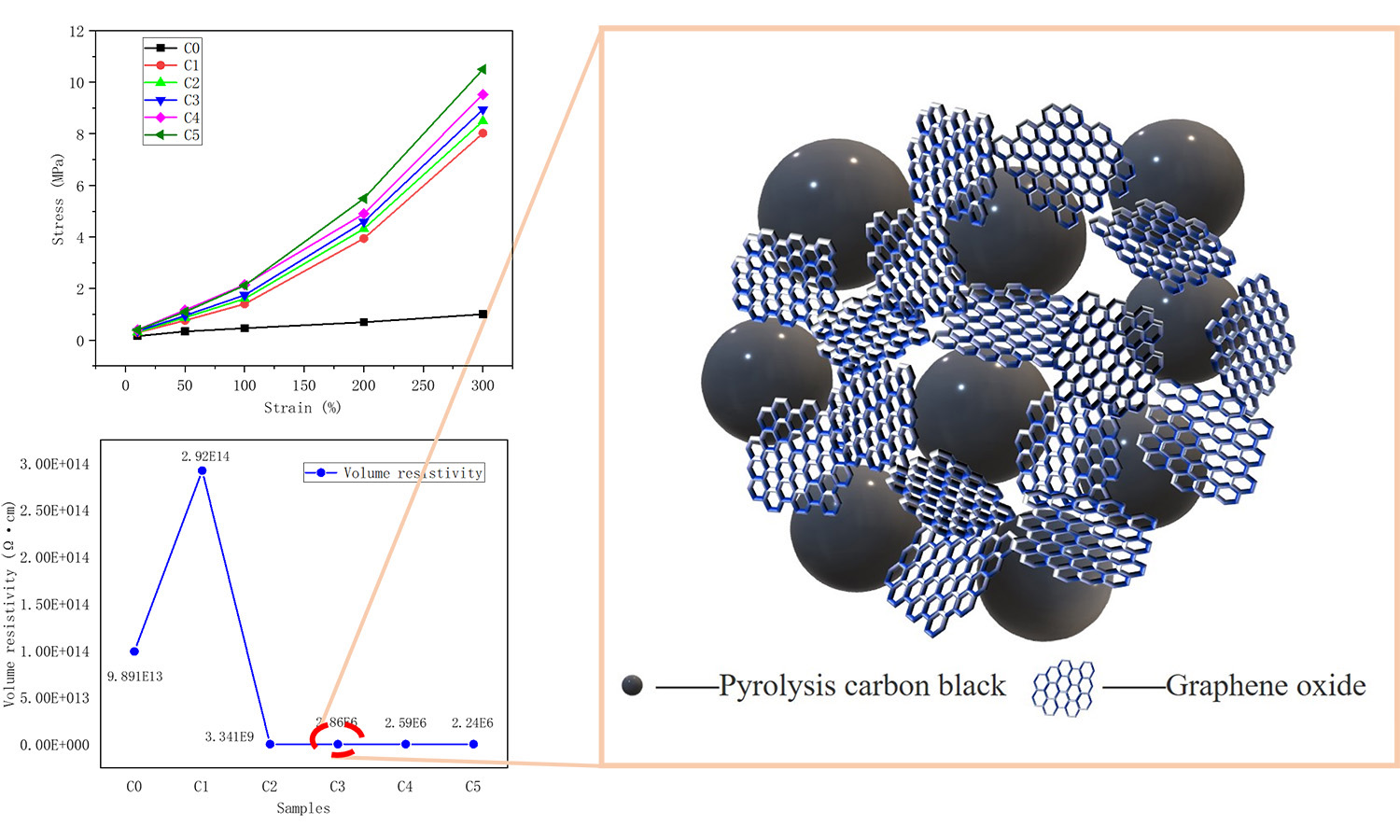
Pyrolytic carbon black (CBp) and graphene oxide (GO) are commonly used to reinforce polymer matrices; however, their tendency to agglomerate limits composite performance. Conventional dual filler systems are frequently costly and challenging to scale. We exploited synergistic CBp-GO interactions to suppress agglomeration and establish a stable filler network, thereby improving the mechanical and electrical properties of natural rubber (NR) composites. Composites were prepared by blending CBp (40 phr) with GO at 0–8 phr. Filler dispersion was characterized by scanning electron microscopy and a carbon black dispersibility tester. Mechanical, vulcanization, and electrical properties were measured. At an optimal CBp/GO ratio of 40:4, a continuous filler network formed, reducing volume resistivity by eight orders of magnitude relative to CBp-only composites and by three orders relative to composites containing 2 phr GO. The 300% modulus increased by 18.3%, and the electrical percolation threshold decreased by 22%. Excess GO (>4 phr) induced agglomeration and reduced tensile strength by 16.4%. A key innovation is the use of CBp in constructing a low-cost multi-filler system that suppresses GO agglomeration without chemical modification. This approach provides a sustainable route to producing highperformance rubber composites and promotes the recycling of waste rubber.
Yijun Liao, Libo Wan, Ting Yin, Yunyi Li, Xiaoli Wu
Vol. 19., No.7., Pages 736-750, 2025
DOI: 10.3144/expresspolymlett.2025.56
Vol. 19., No.7., Pages 736-750, 2025
DOI: 10.3144/expresspolymlett.2025.56
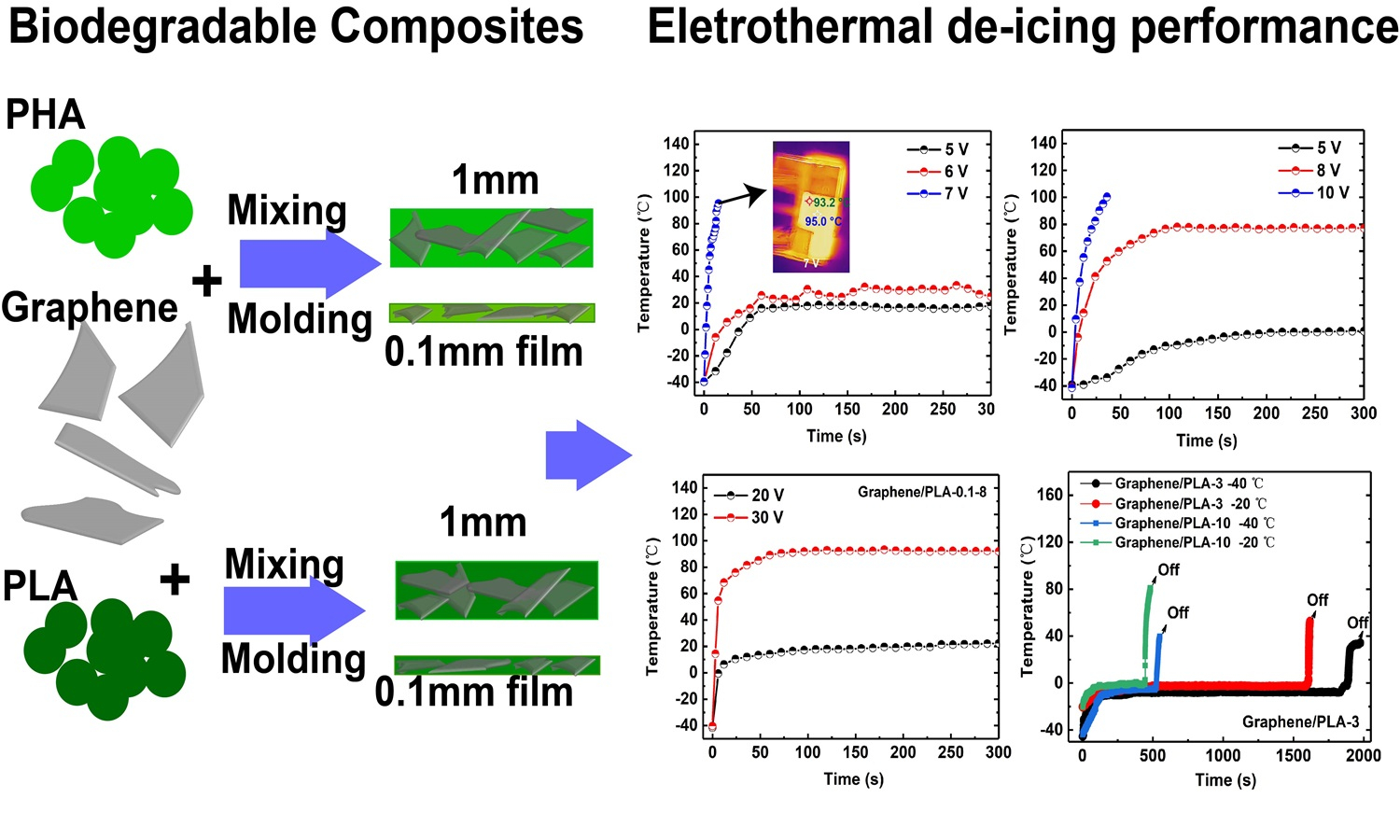
The electrical and electrothermal de-icing performance of graphene/polyhydroxyalkanoates (PHA) and graphene/polylactic acid (PLA) composites with different thicknesses were systematically compared and investigated. Graphene/PHA with 1 mm thickness shows a slightly lower electrical resistivity than graphene/PLA. However, the results are contrary for 0.1 mm-thick samples, likely due to poorer interfacial adhesion between graphene and PHA. Besides, all 0.1 mm-thick samples show higher electrical resistivity than 1 mm-thick samples, likely attributed to the alignment of graphene. The current-voltage curves of graphene/PHA exhibit nonlinear behavior with fluctuations, whereas all graphene/PLA samples show linear behavior. This result enables the graphene/PLA to exhibit superior electrothermal stability than graphene/PHA. An excellent electrothermal performance is obtained for these composites. The temperature increases from –40.2 to 95 °C within 17 s under 7 V. While these composites cannot be self-heated and utilized above 95 °C, this is because the composites would undergo electrical breakdown when heated to temperatures above 95°C for 5~10 s. The composite can melt ice within 550 s at –40 °C and within 447 s at –20 °C. These findings suggest that graphene/PHA and graphene/PLA composites hold significant potential for de-icing applications.
Mathew Olurotimi Adeoti, Tamba Jamiru, Taoreed Adesola Adegbola, Ibrahim Suleiman, Mohammed Abdullahi, Basiru Philip Aramide
Vol. 19., No.2., Pages 208-229, 2025
DOI: 10.3144/expresspolymlett.2025.16
Vol. 19., No.2., Pages 208-229, 2025
DOI: 10.3144/expresspolymlett.2025.16
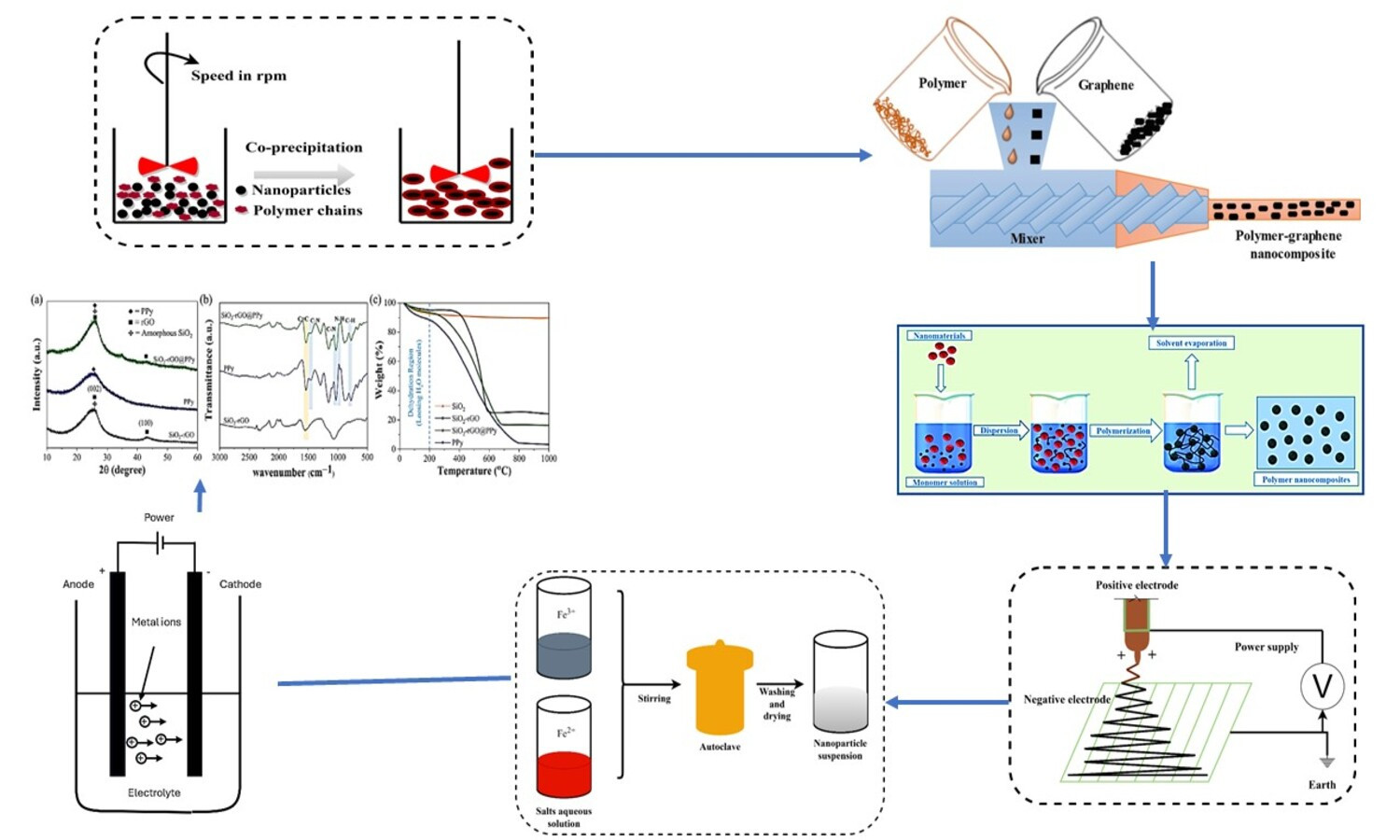
Polymer nanocomposites are drawing considerable interest in electrical energy storage research owing to their distinctive characteristics and promising roles in various devices, such as batteries, supercapacitors, and fuel cells. This review examines the selection criteria of polymer nanocomposites for electrical energy storage applications and the current advancements in developing and producing polymer nanocomposites specifically tailored for electrical energy storage applications. Key topics covered include the selection of polymer matrices, choice of nanofillers, fabrication techniques, characterization methods, and performance evaluation of the resulting nanocomposites. The impact of nanofiller dispersion, interface engineering, and morphology control on electrical storage properties is emphasized. Proper dispersion enhances uniformity and interfacial interactions, improving electrical, mechanical, and thermal properties. Interface engineering boosts polymer-nanofiller compatibility, while morphology control optimizes nanofiller structure and arrangement for better storage efficiency. Emerging trends, challenges, and future research directions are also discussed, providing insights for developing advanced polymer nanocomposites with improved electrical energy storage capabilities.
Péter Csvila, Tibor Czigány
Vol. 18., No.10., Pages 1023-1038, 2024
DOI: 10.3144/expresspolymlett.2024.78
Vol. 18., No.10., Pages 1023-1038, 2024
DOI: 10.3144/expresspolymlett.2024.78
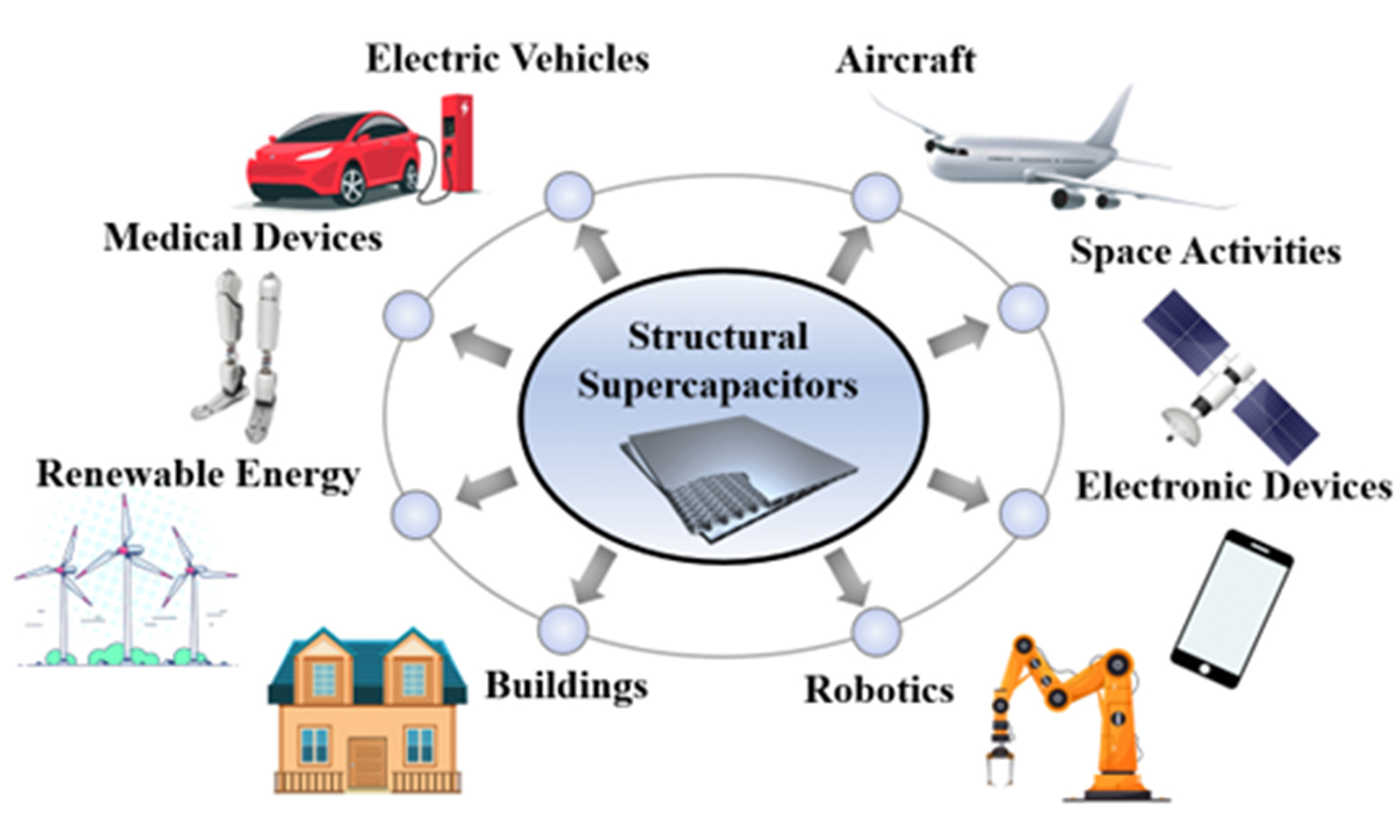
The article gives an overview of energy storage composites, their materials, manufacturing processes, and applications. Carbon- and metal-based nanoparticles and their relevant properties are presented. We focus on multifunctional structural supercapacitors and their components. Thus, we describe the main structural electrolytes and elements of the structural electrodes. We show that the nanoparticles significantly influence the electrochemical properties of the electrode. For example, carbon-based nanoparticles can achieve low energy density but high power density, while the opposite is true for metal-based nanoparticles. We show that when carbon- and metal-based nanoparticles are used together, a positive synergy is created between them, promoting the development of favorable electrochemical properties in the electrodes. Furthermore, we present structural supercapacitors and possible ways to introduce nanoparticles into the system. Finally, we present a summary of the progress achieved so far and the advancements expected in the future, as well as potential areas where structural supercapacitors could be used.