Design of ethylene-methyl acrylate copolymer/chloroprene rubber thermoplastic vulcanizates as heat-triggered triple-shape memory polymers
Dazhi Zhu, Junhao Wang, Yongheng Sun, Jianqiang Chu, Zhaobo Wang
Vol. 19., No.4., Pages 361-371, 2025
DOI: 10.3144/expresspolymlett.2025.27
DOI: 10.3144/expresspolymlett.2025.27
Corresponding author: Zhaobo Wang 
GRAPHICAL ABSTRACT
ABSTRACT
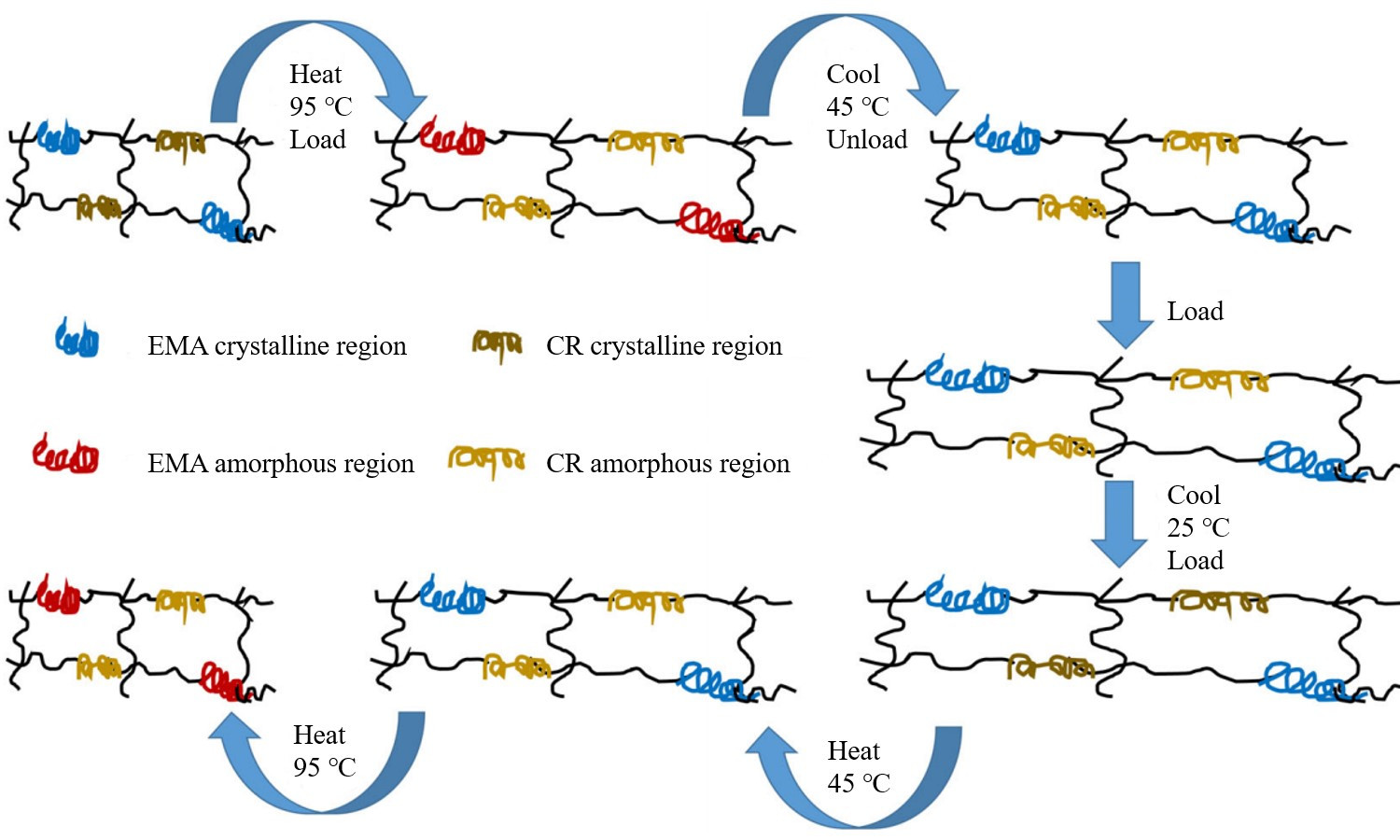
In this research, heat-triggered triple-shape memory polymers (TSMPs) based on the ethylene-methyl acrylate copolymer (EMA)/chloroprene rubber (CR) thermoplastic vulcanizates (TPVs) were prepared by dynamic vulcanization successfully; meanwhile, an effective and facile triple-shape memory strategy was designed to realize the efficient and stable shape fixity and recovery of two temporary shapes. The field-emission scanning electron microscope images showed that EMA/CR TPV surface was a sea-island structure with the CR particle size ranging from 3 to 6 μm. Differential scanning calorimeters and X-ray diffraction were used to investigate the crystallization behavior of both EMA and CR. These served as a significant basis for the two temporary shapes: fixity and recovery. The results of triple-shape memory tests showed that the EMA/CR TPV had excellent triple-shape memory properties, where the first shape fixity ratio was higher than 89% and both the first shape recovery ratio and second shape recovery ratio could be higher than 95%. It can be observed that the EMA/CR TPV exhibited rapid shape recovery speed with the first shape recovery time of 10 s and the second shape recovery time of 20 s, respectively. This research presents a novel approach to extending the application of TPV in the field of smart devices, endowing them with excellent mechanical and triple-shape memory properties.
RELATED ARTICLES
László József Varga, Tamás Bárány
Vol. 20., No.10., Pages 1005-1016, 2026
DOI: 10.3144/expresspolymlett.2026.74
Vol. 20., No.10., Pages 1005-1016, 2026
DOI: 10.3144/expresspolymlett.2026.74
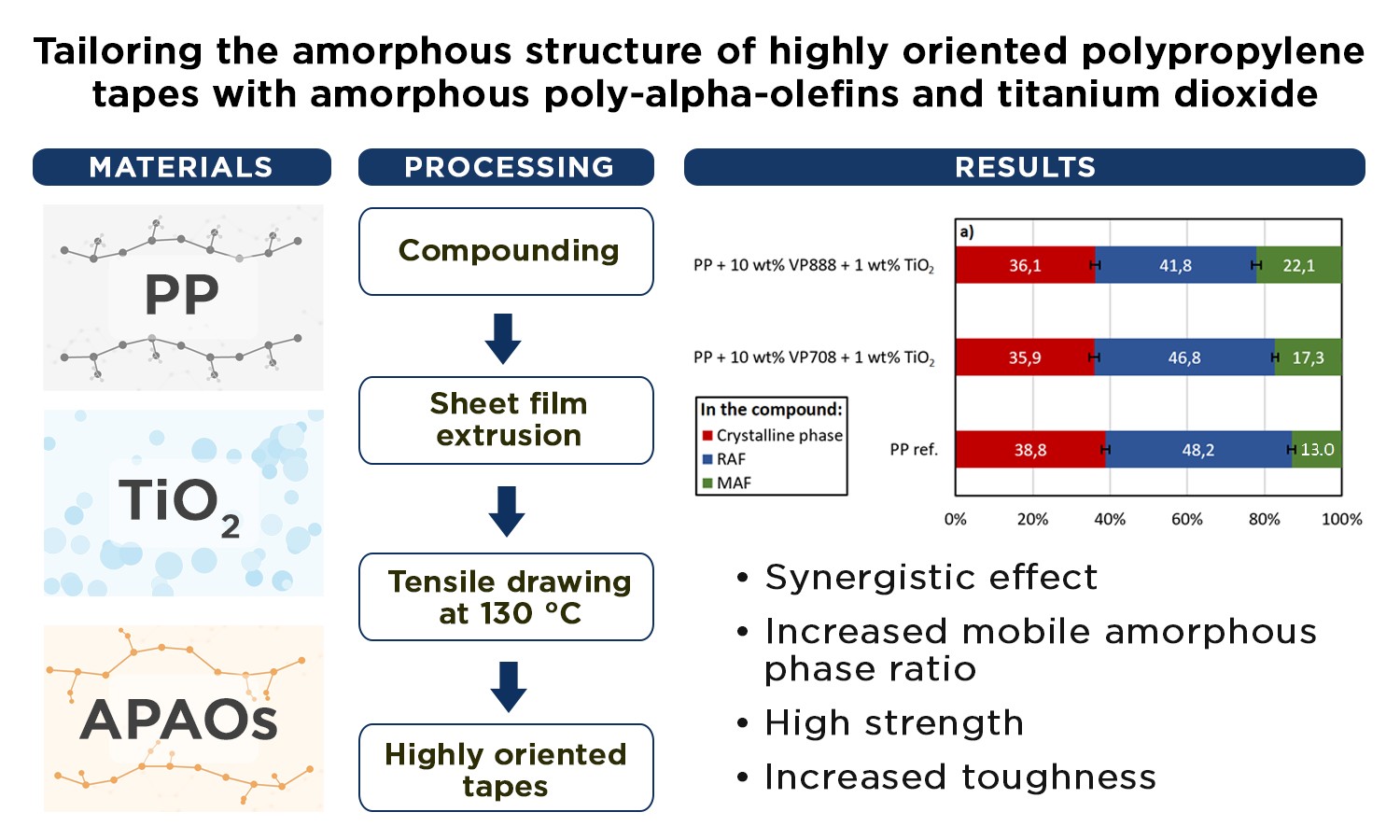
Highly oriented polypropylene tapes exhibit excellent strength and stiffness but limited ductility. In this study, we investigated the individual and combined effects of two amorphous poly-alpha-olefins (APAOs) and titanium dioxide (TiO2) on the structure and mechanical properties of drawn polypropylene tapes. Both APAOs reduced the specific work of drawing, while TiO2 increased tensile strength and strain at break without reducing stiffness. The combined modifications produced the greatest improvement in ductility, particularly with the APAO containing a minor crystalline fraction and TiO2, which increased tensile strength from 343 to 388 MPa and strain at break from 12.4 to 32.3%. X-ray diffraction revealed similarly high crystalline orientation for all compositions. Modulated differential scanning calorimetry after a standardized thermal cycle revealed an increased mobile amorphous fraction and a reduced rigid amorphous fraction, suggesting that changes in amorphous-phase constraints contribute to the improved deformability. These results demonstrate that complementary tailoring of the amorphous phase can substantially improve the strength–ductility balance of highly oriented polypropylene tapes.
Zhen Chen, Liang Xu, Yu Bai, Wei Wang , Junfeng Qian, Xiaoliang Yin, Jizhou Du, Jing Zhang
Vol. 20., No.7., Pages 724-741, 2026
DOI: 10.3144/expresspolymlett.2026.55
Vol. 20., No.7., Pages 724-741, 2026
DOI: 10.3144/expresspolymlett.2026.55
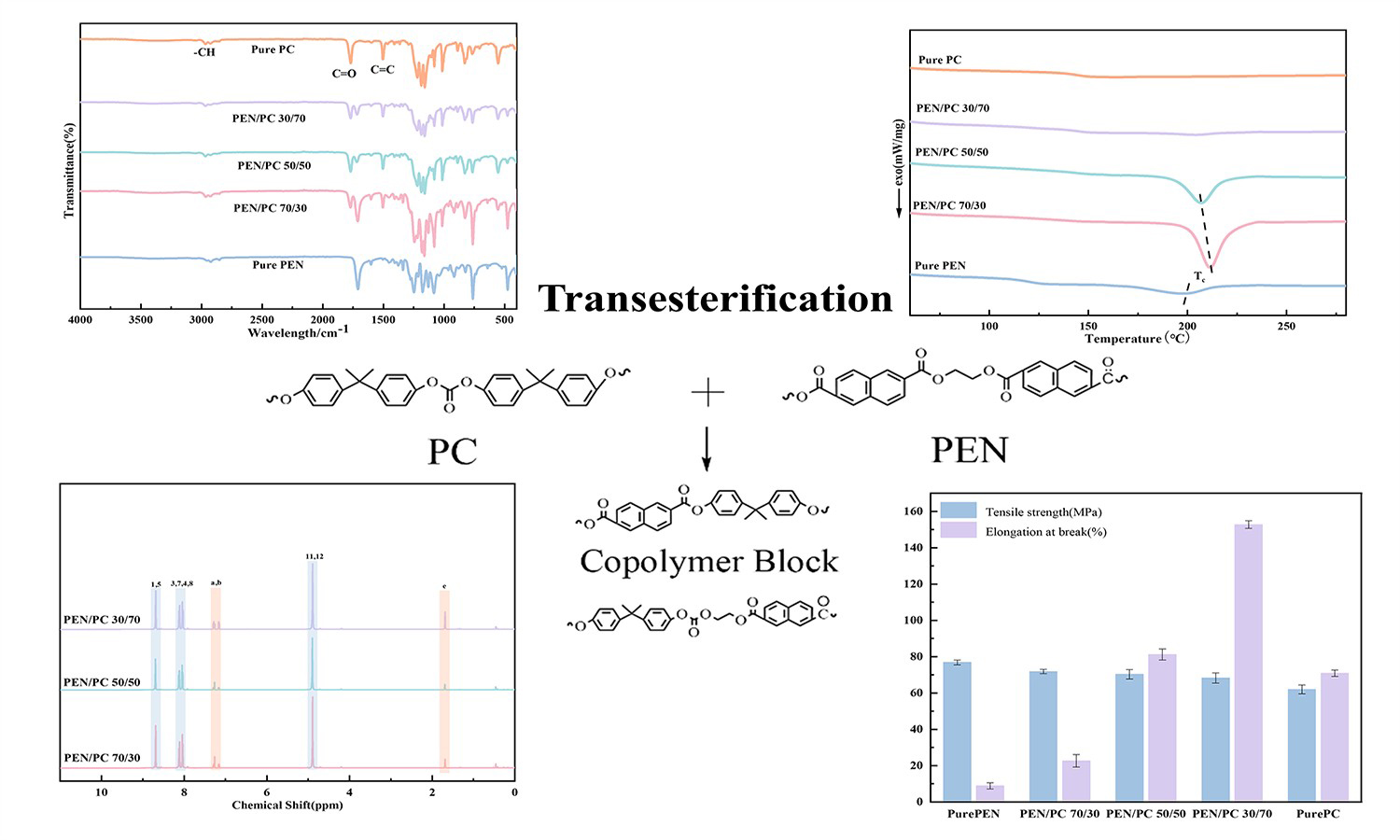
Conventional poly(ethylene terephthalate) (PET) and polycarbonate (PC) blends exhibit insufficient heat resistance, restricting their use in demanding applications such as new energy vehicles and portable consumer electronics. Poly(ethylene 2,6-naphthalate) (PEN) offers superior thermal stability, strength and chemical resistance, making PEN/PC blends promising alternatives. In this study, we investigated the relationships between the composition, structure and properties of PEN/PC blends through non-catalyzed melt blending. Fourier transform infrared spectroscopy (FTIR) and proton nuclear magnetic resonance spectra (1H NMR) confirm transesterification between PEN and PC, with the extent of exchange (X) increasing with PC content. Non-isothermal differential scanning calorimetry (DSC) and X-ray diffraction (XRD) show that moderate PC content promotes crystallization, while high PC content suppresses it. Thermogravimetric analysis (TGA) shows enhanced thermal stability in PEN-rich blends. Compared to PET/PC, PEN/PC blends maintain similar tensile strength but exhibit 53% higher elongation and 1–2.5% lower density. This study demonstrates the potential of PEN/PC blends for high-performance, thin-walled applications in the new energy vehicle and electronics industries.
Joanna Szymańska, Wojciech Hubert Bednarek, Beata Strzemiecka, Dominik Paukszta
Vol. 20., No.5., Pages 501-513, 2026
DOI: 10.3144/expresspolymlett.2026.38
Vol. 20., No.5., Pages 501-513, 2026
DOI: 10.3144/expresspolymlett.2026.38
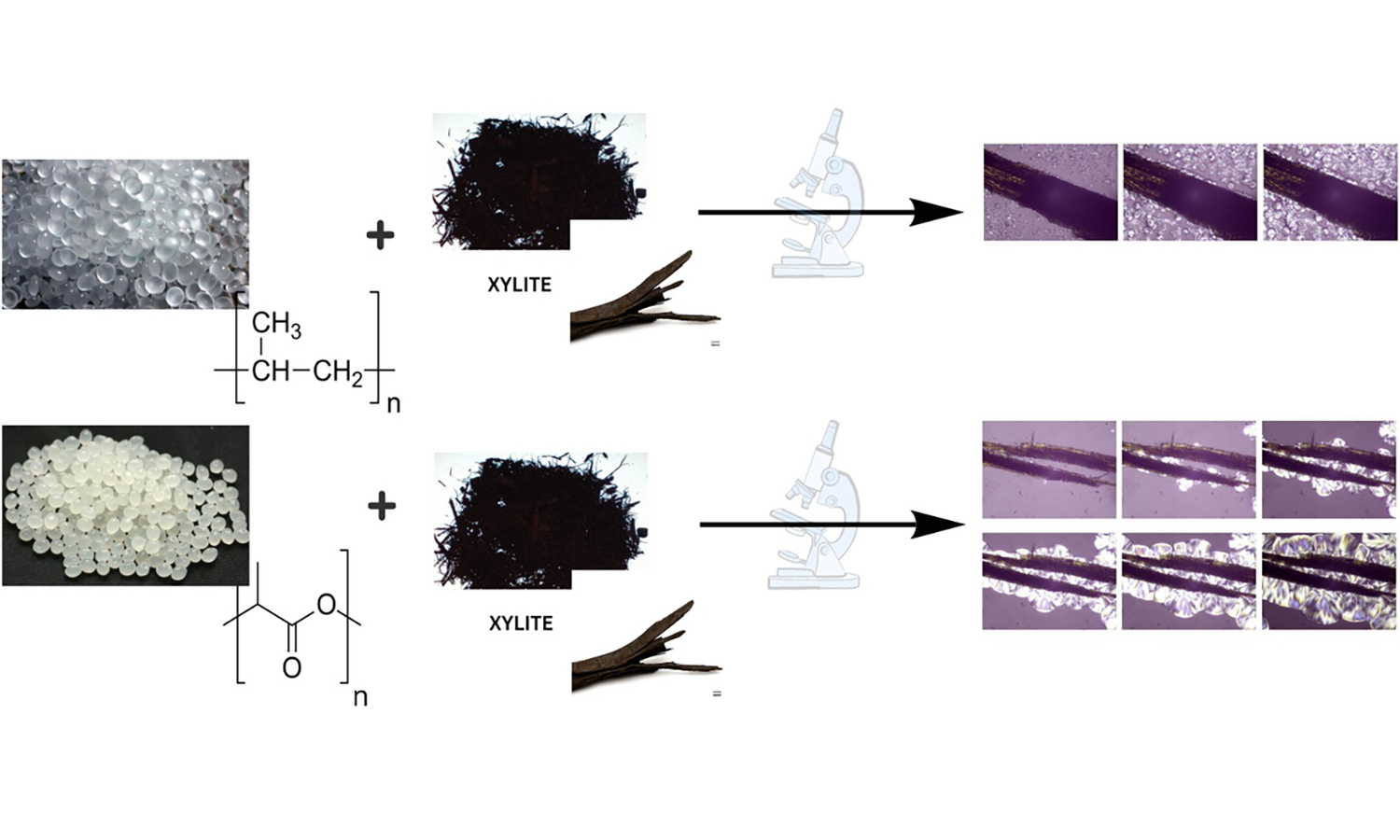
Crystallinity describes the degree of structural order in solids, and in polymers it strongly influences rheological, mechanical, thermal, and optical properties as well as degradation. In this study, we investigate how adding a xylitic brown coal fraction affects the crystallization of polylactide (PLA) and polypropylene (PP) under static and shear conditions. We characterized composites by wide-angle X-ray scattering (WAXS), Fourier transform infrared spectroscopy (FTIR), polarization light microscopy (PLM), scanning electron microscopy (SEM) and scanning electron microscopy with energy-dispersive X-ray spectroscopy (SEM-EDS) to examine both crystallization and filler structure. Results show that the lignocellulosic filler markedly alters crystallization kinetics and supramolecular morphology. In PLA-based composites, a transcrystalline layer (TCL) developed at the interface, modifying crystallization and reducing spherulite formation. In PP, only a weak TCL developed due to limited interfacial compatibility. Under shear, PP displayed the expected acceleration of spherulite growth, while PLA showed competing mechanisms between spherulitic nucleation and TCL formation. These findings highlight the role of natural, hybrid organic–mineral fillers in tailoring polymer crystallization processes and improving composite design.
Markus Gahleitner
Vol. 20., No.5., Pages 435-436, 2026
DOI: 10.3144/expresspolymlett.2026.33
Vol. 20., No.5., Pages 435-436, 2026
DOI: 10.3144/expresspolymlett.2026.33
This is an editorial article. It has no abstract.
Jana Navratilova
Vol. 20., No.2., Pages 112-113, 2026
DOI: 10.3144/expresspolymlett.2026.9
Vol. 20., No.2., Pages 112-113, 2026
DOI: 10.3144/expresspolymlett.2026.9
This is an editorial article. It has no abstract.