
Electrospun cellulose acetate/zeolite fibrous mats: Physicochemical characterization and influence of zeolite type on mat structure, CO2 adsorption, and H2 permeability
Yarledis Hurtado-Henao , Adriana Blanco-Leal, Nicole Butto, Andrónico Neira-Carrillo, Francisco Gracia, Omar D. Gutiérrez, María Elena Moncada-Acevedo, Estefanía Correa-Muñoz
, Adriana Blanco-Leal, Nicole Butto, Andrónico Neira-Carrillo, Francisco Gracia, Omar D. Gutiérrez, María Elena Moncada-Acevedo, Estefanía Correa-MuñozVol. 20., No.6., Pages 563-578, 2026
DOI: 10.3144/expresspolymlett.2026.43
DOI: 10.3144/expresspolymlett.2026.43
Corresponding author: Estefanía Correa-Muñoz 
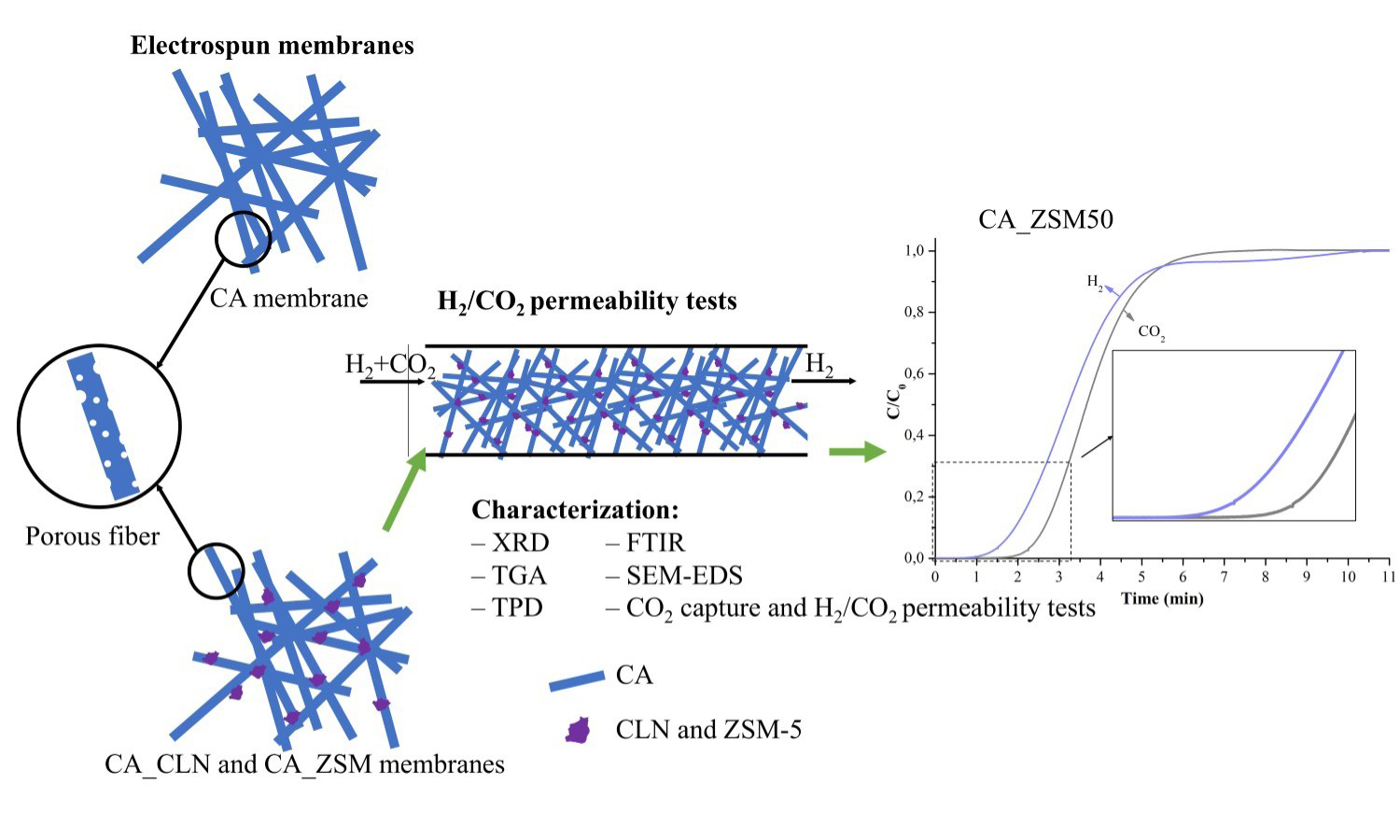
GRAPHICAL ABSTRACT
ABSTRACT
The increasing release of greenhouse gases (GHGs), particularly CO2, continues to drive global warming and highlights the need for effective mitigation technologies. In this study, porous nanostructured cellulose acetate (CA) fibrous mats were fabricated via electrospinning and integrated with natural clinoptilolite (CLN) and synthetic ZSM-5 zeolites to improve CO2 capture. Physicochemical characterization, elemental analysis, FTIR, XRD, SEM–EDS, and TGA confirmed the incorporation of zeolitic fillers and revealed their influence on fiber structure and thermal stability. We conducted CO2 adsorption and H2/CO2 permeability tests to assess the feasibility of the electrospun fibrous mats for pre-combustion hydrogen purification. CA/ZSM-5 fibrous mats showed enhanced fiber uniformity, improved thermal stability, and superior CO2 adsorption and H2 separation performance, whereas CA/CLN fibrous mats exhibited good CO2 capture but limited hydrogen selectivity. These results demonstrate that zeolite type governs the structural and functional behavior of electrospun CA hybrid fibrous mats, offering insights for developing sustainable materials for gas separation.
RELATED ARTICLES
Mehmet Selim Demirtaş, Mrinal C. Saha
Vol. 18., No.8., Pages 851-867, 2024
DOI: 10.3144/expresspolymlett.2024.63
Vol. 18., No.8., Pages 851-867, 2024
DOI: 10.3144/expresspolymlett.2024.63
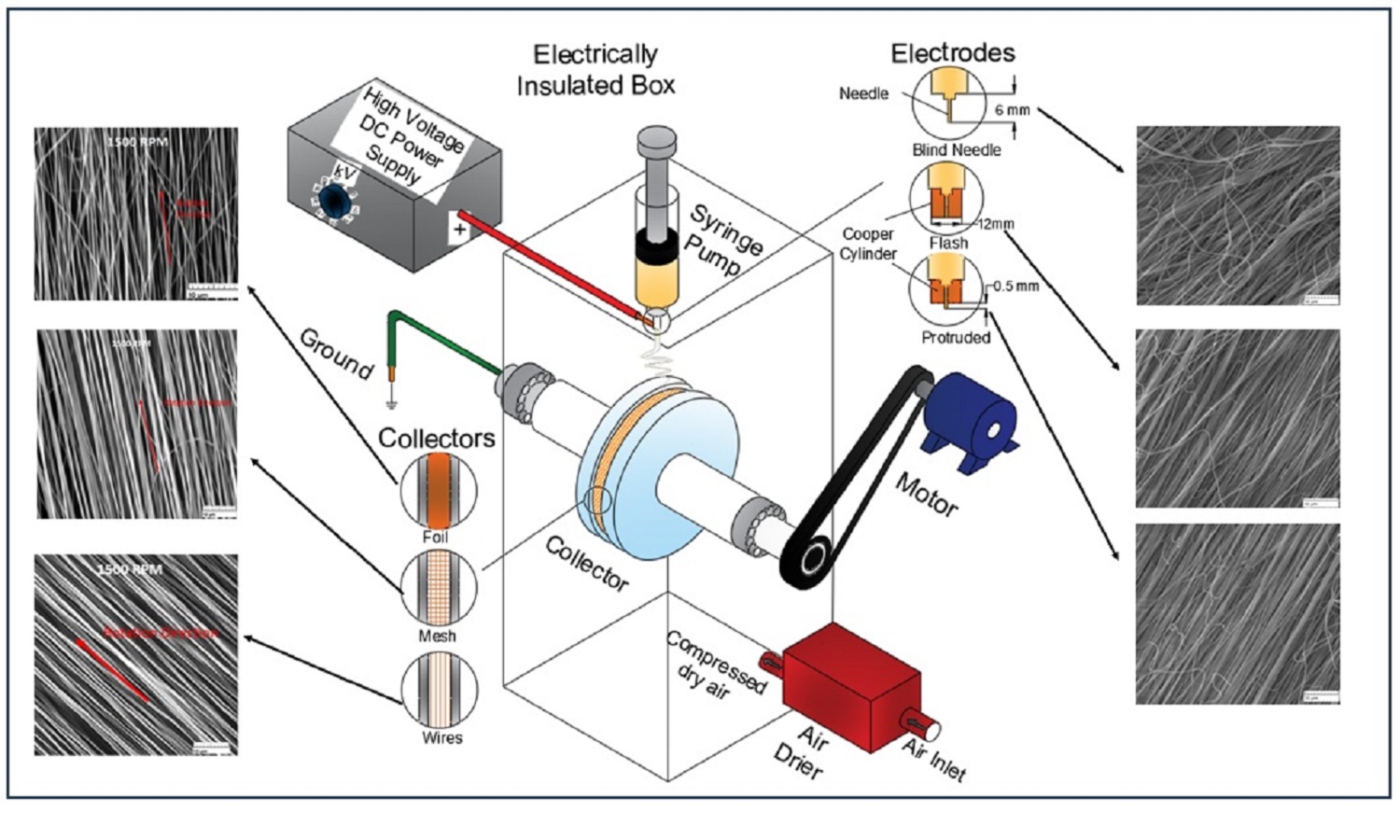
Nanomaterials, particularly nanofibers produced through electrospinning, have garnered significant attention due to their unique properties and diverse applications. This research explores the influence of collector design, electrode geometry, and collector speed on the properties of electrospun polyacrylonitrile (PAN) nanofibers. Finite element analysis (FEA) was employed to simulate electric fields, revealing the impact of collector geometry on field intensity. The experimental setup, enclosed in an isolated chamber, employed various collector types and electrode configurations. Scanning electron microscope (SEM) analysis showcased the effect of collector speed on fiber alignment and diameter. Furthermore, FEA simulations elucidated the role of electrode geometry and voltage in shaping the electric field, impacting fiber properties. The study introduces a novel, in-house method for producing highly aligned nanofibers and provides insights into optimizing electrospinning parameters for enhanced fiber properties. A testing protocol is devised to minimize surface damage when conducting mechanical tests on nanofiber films, employing a dynamic mechanical analyzer (DMA). Mechanical testing demonstrated the correlation between alignment and tensile strength. Overall, this research contributes valuable insights for tailoring electrospinning processes for tissue engineering and energy storage.