
Ultrasonic polymer melt processing: Mechanisms, processing windows and industrial perspectives
Germán Pérez-Llanos, Anyi Jin, Omid Yousefzade , Luis J. del Valle, Jordi Puiggalí
, Luis J. del Valle, Jordi PuiggalíVol. 20., No.6., Pages 637-661, 2026
DOI: 10.3144/expresspolymlett.2026.48
DOI: 10.3144/expresspolymlett.2026.48
Corresponding author: Jordi Puiggalí 
GRAPHICAL ABSTRACT
ABSTRACT
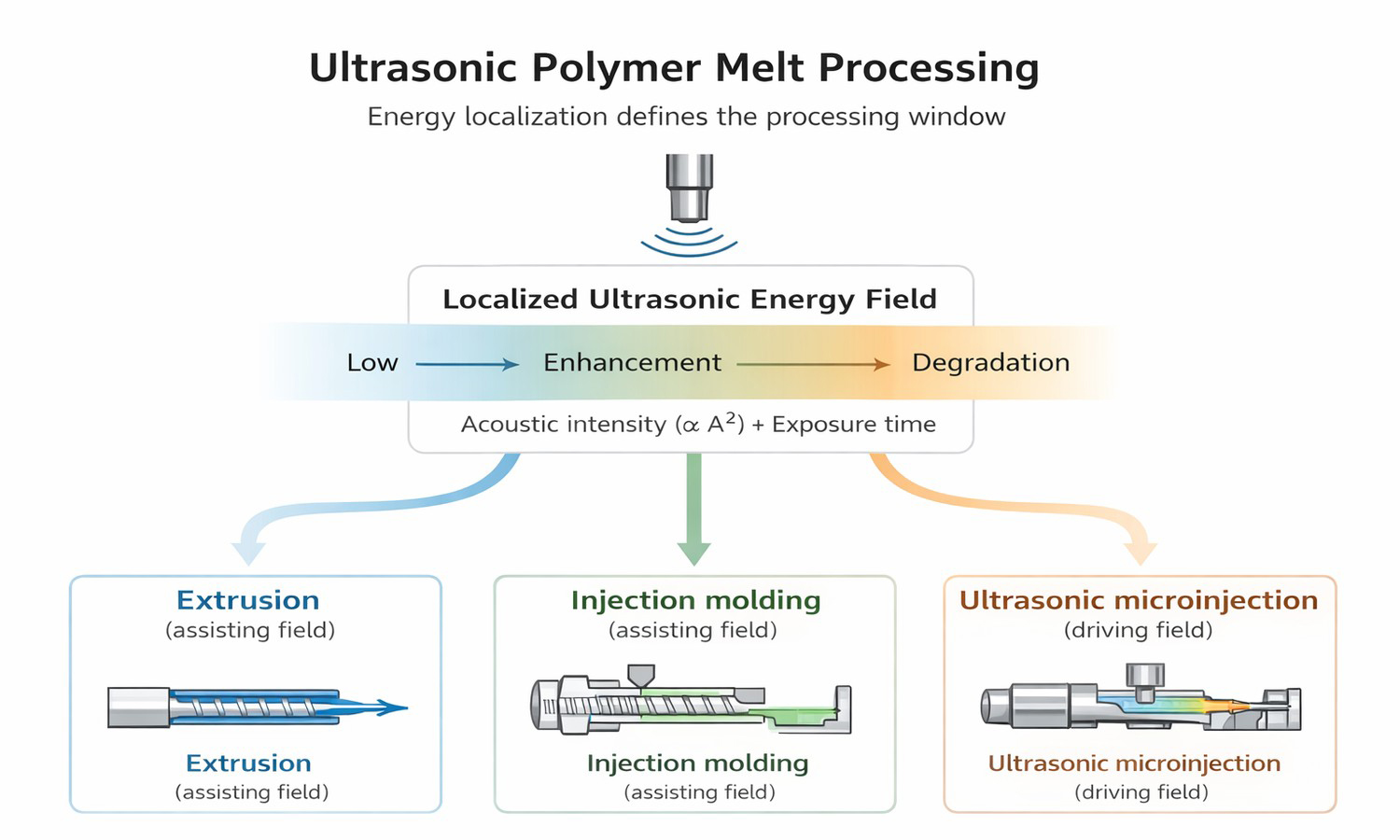
The integration of ultrasonic energy into polymer melt processing enables control of melt-state dynamics and microstructure evolution in thermoplastic systems. By superimposing high-frequency mechanical vibrations onto conventional thermal and shear fields – or directly driving polymer plastification – ultrasound can induce transient viscosity reduction in many polymer systems, depending on material characteristics and processing conditions, improve filler dispersion, influence crystallization behavior and enhance flow stability under controlled conditions. This review presents a critical assessment of ultrasonic technologies in extrusion, injection molding and ultrasonic microinjection molding. Fundamental ultrasonic–polymer interactions – including oscillatory shear, viscoelastic dissipation and localized heating – are examined in relation to processing configuration and material response. Emphasis is placed on acoustic intensity, exposure time and energy localization in defining a processing window separating reversible rheological enhancement from irreversible molecular degradation. Across processing routes, ultrasonic activation can improve cavity filling, suppress melt fracture, refine morphology and facilitate nanocomposite processing and recycling. However, challenges related to spatial energy heterogeneity, scalability and industrial integration remain. Ultrasonic technologies should be regarded as energy-localized tools capable of expanding controllable processing windows when properly optimized.