
Determination of wall thickness effect of in-mold viscosity measurement under non-adiabatic, non-isothermal flow conditions
Szabolcs Horváth , József Gábor Kovács
, József Gábor KovácsVol. 19., No.3., Pages 246-257, 2025
DOI: 10.3144/expresspolymlett.2025.19
DOI: 10.3144/expresspolymlett.2025.19
Corresponding author: József Gábor Kovács 
GRAPHICAL ABSTRACT
ABSTRACT
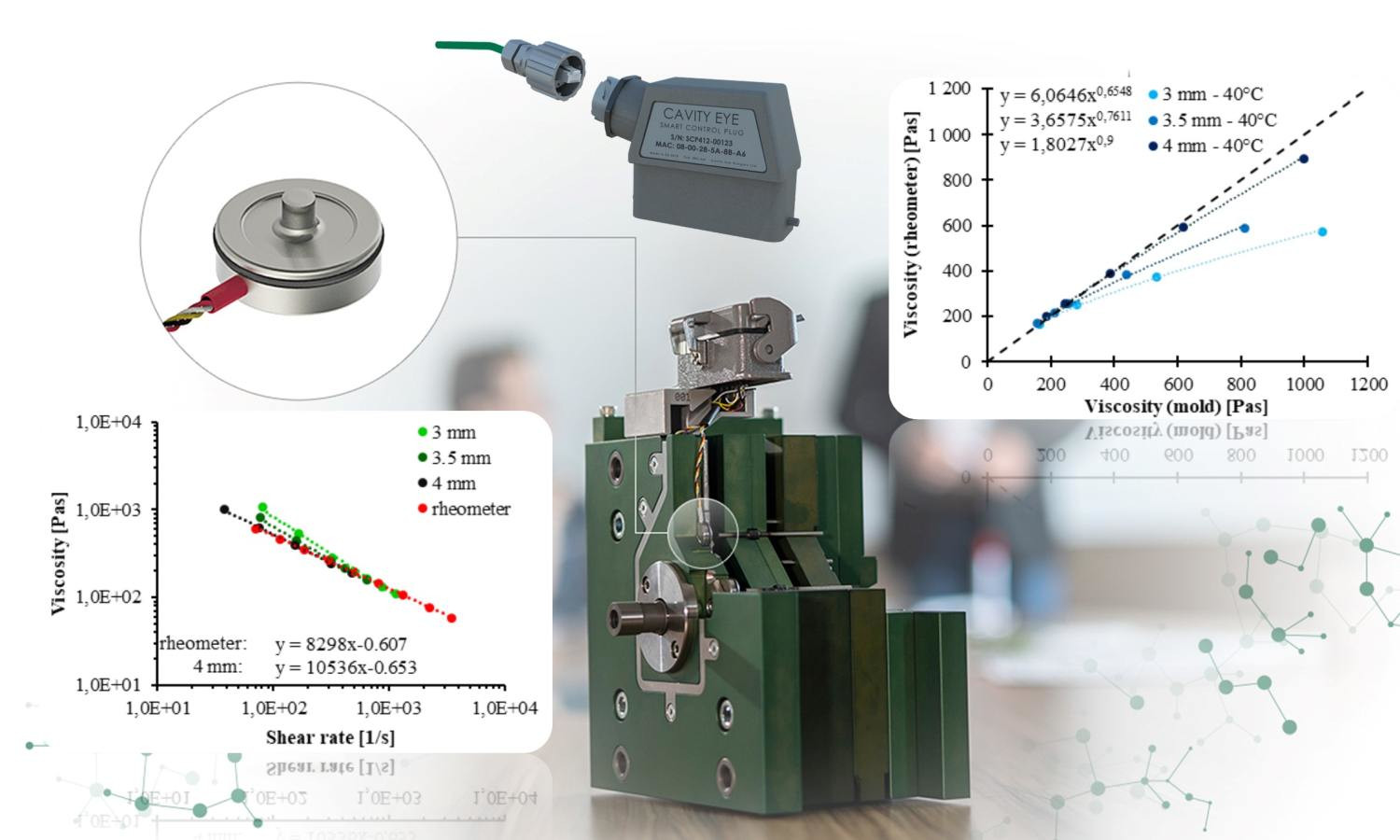
Measuring the viscosity of the melt contributes to the quality of injection molded products. Injection molding machines cannot give much feedback on the processes in the cavity, so pressure measurement inside the mold facilitates quality supervision. Our goal is to get more information about the viscosity of the material during filling in a traditional injection mold. A suitable and cost-effective method is to install cavity pressure sensors for the in-situ viscosity measurement. We prepared an experimental mold with variable wall thickness and 80×80 mm cavity dimensions. We implemented eight pressure sensors in each cavity. The wall thickness varied from 1 to 4 mm, and apparent viscosity was determined at different shear rates and mold temperatures. We measured non-isothermal and non-adiabatic flow during filling. The environment was quite different from that of standard measuring equipment. Based on the results, we effectively measured the material viscosity with a non-heated mold in the case of acrylonitrile-butadiene-styrene (ABS) and polypropylene (PP) material. The results were validated by measuring viscosity with a capillary rheometer and compared to our method using the non-heated mold, and the error was less than 10%. The results were accurate in a specific speed wall thickness range with PP and ABS.
RELATED ARTICLES
Sudheesh Parathakkatt, Vaisakh Kizhuveetil, Gokul G. K., Rajashree Ajay Markandewar
Vol. 20., No.5., Pages 473-488, 2026
DOI: 10.3144/expresspolymlett.2026.36
Vol. 20., No.5., Pages 473-488, 2026
DOI: 10.3144/expresspolymlett.2026.36

Worm-like micelles (WLMs) are dynamic, self-assembling supramolecular structures that exhibit complex viscoelastic behaviour due to their ability to undergo reversible scission, fusion, branching, and sequence rearrangement. This review provides a comprehensive analysis of recent theoretical advances in modelling WLM rheology, from classical reptation–scission theories to modern stochastic simulations and multi-scale population-balance frameworks. A central challenge addressed is the rheological indistinguishability of competing models under linear conditions, which renders inverse modelling ill-posed and necessitates the integration of experimental data, such as cryogenic transmission electron microscopy (cryo-TEM), small-angle neutron scattering (SANS), and flow birefringence, to constrain theoretical predictions. The article further explores the limitations of conventional models in capturing nonlinear responses, including shear banding and extensional strain hardening, and emphasizes the need for spatially resolved, structurally informed constitutive equations. Emerging tools, including neural networks and hybrid modular frameworks, are identified as promising solutions for bridging microscopic rearrangement dynamics with macroscopic flow behaviour. Ultimately, the development of predictive, physically grounded WLM models will be essential for advancing applications in formulation science, smart materials, and industrial processing.
Amanda Legnani, André Luis Marcomini, Philipe Augusto Pocidonio Silva, Ricardo Geraldo de Sousa, Anderson Júnior dos Santos, João Paulo Ferreira Santos
Vol. 20., No.4., Pages 326-341, 2026
DOI: 10.3144/expresspolymlett.2026.26
Vol. 20., No.4., Pages 326-341, 2026
DOI: 10.3144/expresspolymlett.2026.26
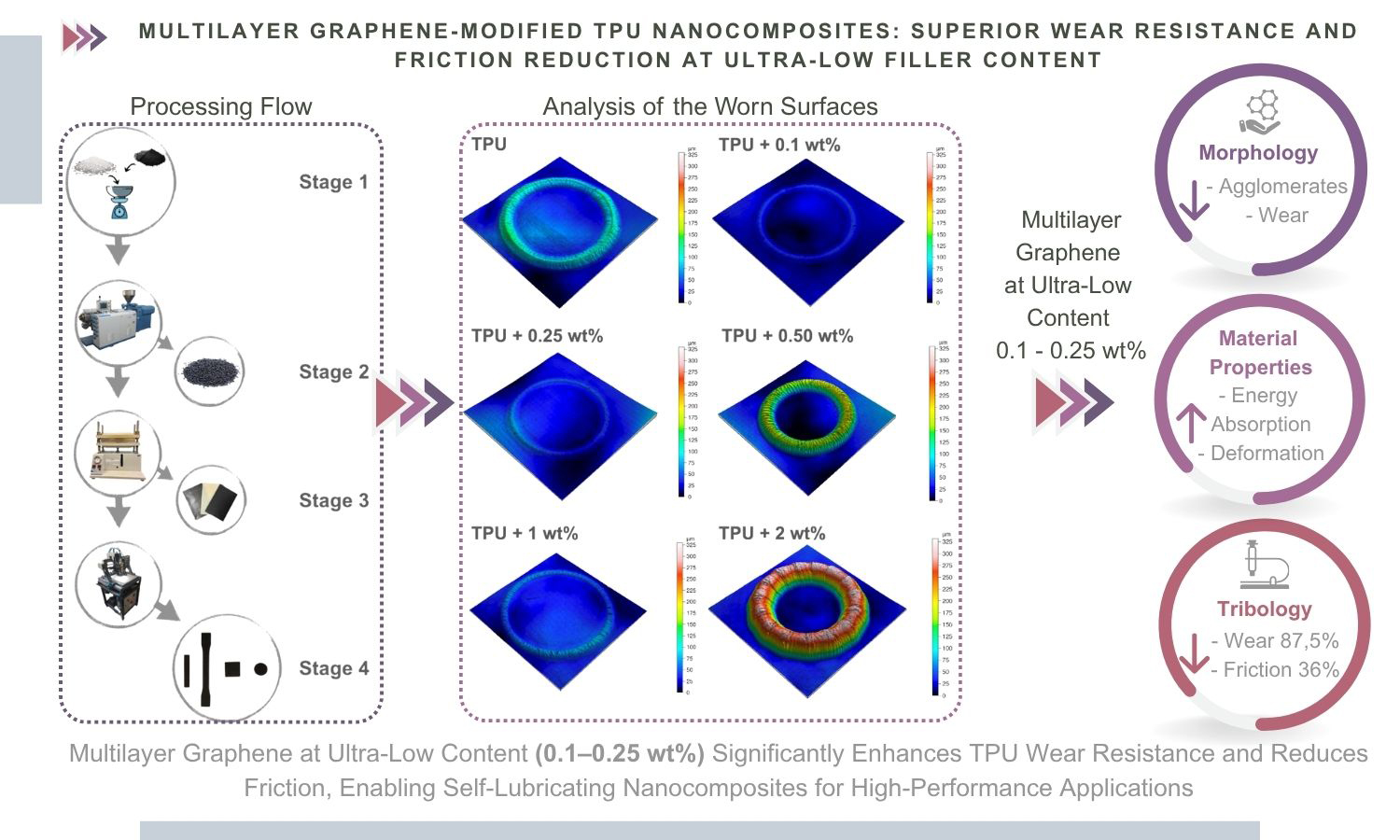
This work presents the development of high-performance thermoplastic polyurethane (TPU) nanocomposites reinforced with low contents of multilayer graphene (mG), aiming to improve their tribological behavior. Using twin-screw extrusion followed by hot pressing, nanocomposites containing 0.1, 0.25, 0.5, 1, and 2% mG weight were fabricated and systematically evaluated. Nanocomposites with only 0.1–0.25 wt% mG achieved a 36% reduction in friction coefficient and 87.5% reduction in wear volume compared to neat TPU. Results are rarely reported at such low filler loadings. Scanning electron microscopy (SEM) analysis revealed uniform dispersion at these optimal concentrations, while higher mG contents led to agglomeration and performance loss. Rheological studies indicated improved flow behavior, and dynamic-mechanical analysis confirmed increased energy dissipation and thermal response. These results suggest that the concentrations of 0.1% and 0.25% of multilayer graphene used in the study are promising for improving the performance of TPU nanocomposites in applications requiring high wear resistance for advanced applications in automotive, biomedical, and high-load engineering components, where durability and low friction are essential.