
Reinforcing effect of thermo-oxidative reclaimed rubber on NR/SBR blends for tire tread applications
Yunhui Xu, Zaheer ul Haq , Junrong Li, Hui Tu, Zaixue Wang, Houluo Cong
, Junrong Li, Hui Tu, Zaixue Wang, Houluo CongVol. 20., No.2., Pages 142-153, 2026
DOI: 10.3144/expresspolymlett.2026.12
DOI: 10.3144/expresspolymlett.2026.12
Corresponding author: Zaheer ul Haq 
GRAPHICAL ABSTRACT
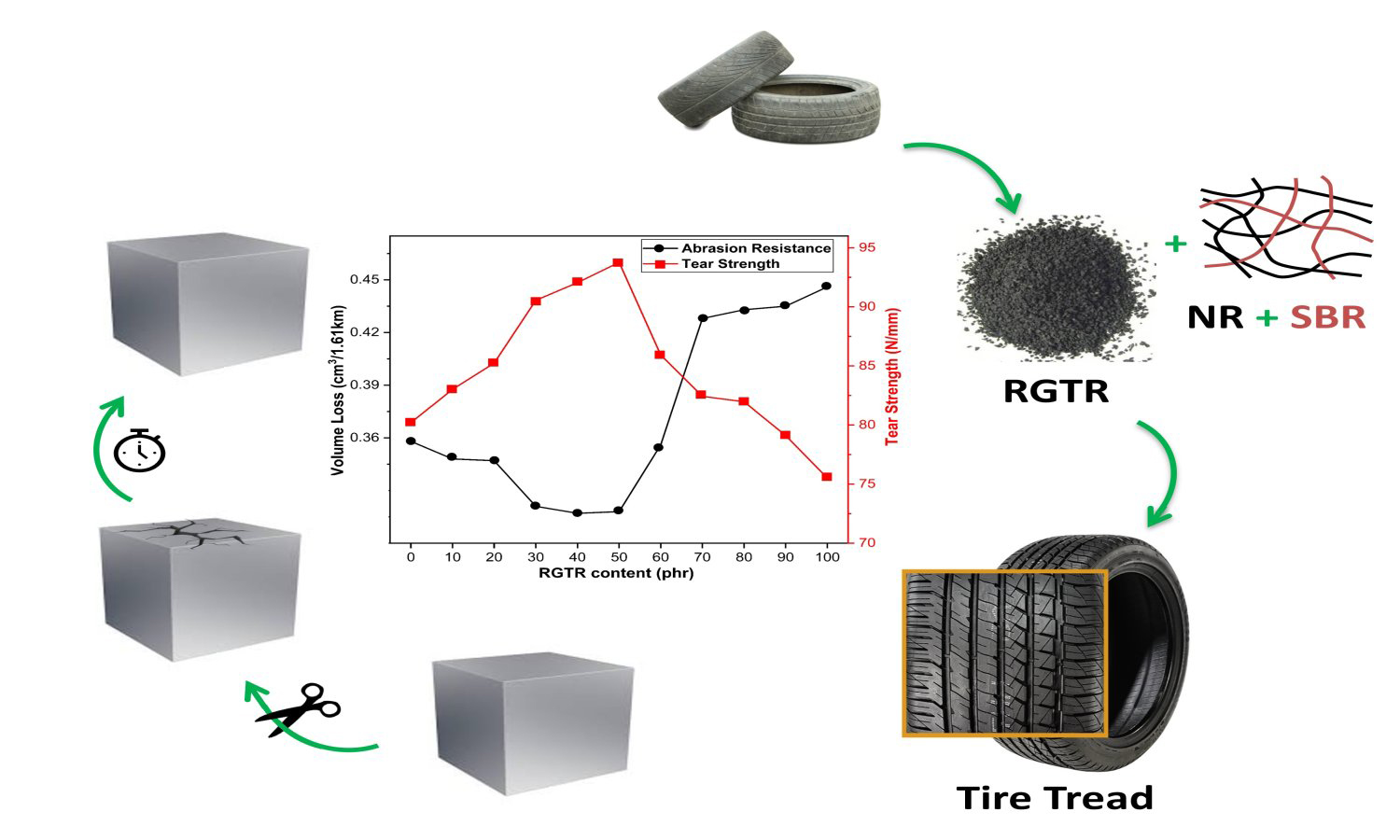
ABSTRACT
This study explores the application of thermo-oxidative reclaimed ground tire rubber (RGTR) in natural rubber (NR)/styrene butadiene rubber (SBR) composite, focusing on its impact on morphology, mechanical properties, rheological behavior, vulcanization characteristics, aging resistance, tear strength and abrasion resistance. The findings revealed that RGTR enhances the tear strength and abrasion resistance of NR/SBR composites while maintaining comparable tensile strength, elongation at break, and modulus. The incorporation of RGTR reduced Mooney viscosity of the NR/SBR composites and improved flowability. It also shortened the vulcanization time and enhanced vulcanization efficiency. The NR/SBR composites with RGTR loadings below 60 phr exhibited optimal performance, achieved a maximum tear strength of 93.77 N/mm and improved abrasion resistance. However, higher RGTR content led to increased agglomeration, as evidenced by scanning electron microscopy (SEM), which showed finer dispersion at lower RGTR contents and larger aggregates at higher loadings. These findings demonstrate the potential of RGTR as a sustainable additive for enhancing specific properties in NR/SBR composites, contributing to both performance optimization and waste tire management.
RELATED ARTICLES
Andrea Kohári, Tamás Bárány
Vol. 20., No.9., Pages 923-938, 2026
DOI: 10.3144/expresspolymlett.2026.68
Vol. 20., No.9., Pages 923-938, 2026
DOI: 10.3144/expresspolymlett.2026.68

The virgin polymer content of thermoplastic polyurethane (TPU) can be reduced with the use of recycled tire rubber, but blend properties strongly depend on the structure of the rubber phase. In this study, we compared TPU-based compounds containing ground tire rubber (GTR), devulcanized GTR (dGTR) and dynamically revulcanized dGTR in terms of mechanical and rheological behavior. GTR-filled blends showed higher tensile strength at the same rubber content, whereas dGTR-containing blends exhibited higher elongation at break up to 40 wt% rubber. Among the thermoplastic dynamic vulcanizates, peroxide-cured blends provided higher tensile strength, higher elongation at break and lower compression set than sulfur-cured blends. The rubber phase also strongly affected melt rheology: dGTR-containing blends showed higher storage modulus (G′) and complex viscosity (η*) than the corresponding GTR-filled blends over the entire frequency range. In contrast, there were only minor rheological differences between sulfur- and peroxide-cured systems, indicating that rubber content had a stronger effect on melt behavior than the curing system. The novelty of this study is the direct comparison of GTR, dGTR and dynamically revulcanized dGTR within the same TPU matrix, showing how the breakdown and partial rebuilding of the recycled rubber network can be used to tune both solid-state properties and melt processability in TPU compounds with high recycled content.
Nabil Hayeemasae, Siriwat Soontaranon, Abdulhakim Masa
Vol. 20., No.7., Pages 664-676, 2026
DOI: 10.3144/expresspolymlett.2026.50
Vol. 20., No.7., Pages 664-676, 2026
DOI: 10.3144/expresspolymlett.2026.50
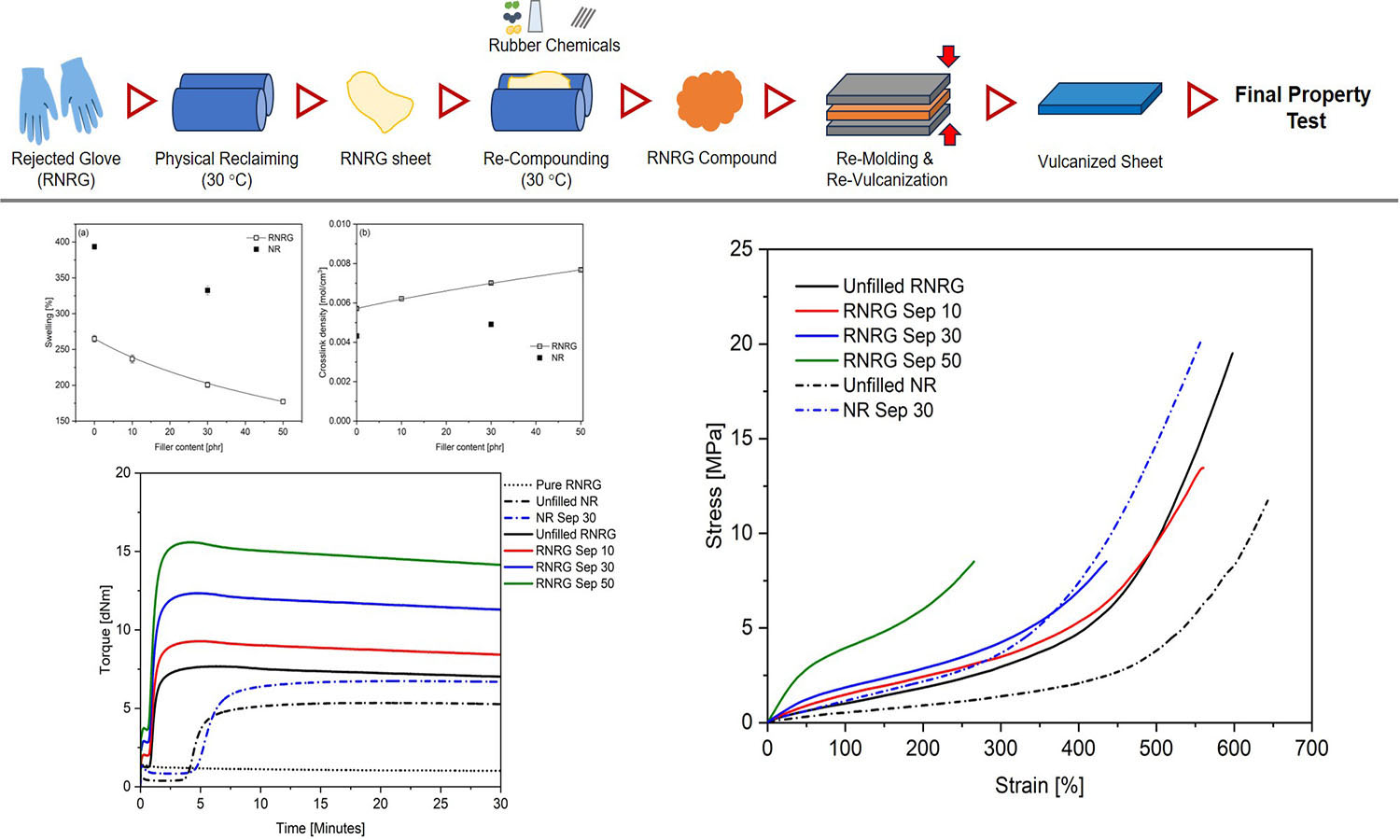
We investigated the possibility of applying rejected natural rubber gloves (RNRGs) as a matrix for rubber composites filled with sepiolite. The virgin natural rubber (NR) samples were also prepared for comparison. Clearly, the RNRGs can be re-mixed with rubber chemicals, re-shaped, and revulcanized. Maximum torque increased with sepiolite loading during vulcanization, along with stress at 100 and 300% strains and strain-induced crystallization ability, whereas the tensile strength and elongation at break of the RNRG composites exhibited an opposite trend. The unfilled RNRG possessed high tensile strength (~19.86 MPa) and extensibility (~600%), which was about 67% higher than that of the unfilled NR sample. However, increased sepiolite loading decreased the thermomechanical properties of the RNRG composites because the RNRG had undergone vulcanization before re-mixing and revulcanizing; the NR-based composite showed the opposite trend. Based on the results, the RNRGs can be re-used as the rubber matrix of rubber compounds when thermal properties are not critical.
Wu Qin, Rui Zhang, Long Zheng, Danling Wang, Sheng Chen, Huiming Ren, Shui Hu, Shipeng Wen
Vol. 20., No.6., Pages 551-562, 2026
DOI: 10.3144/expresspolymlett.2026.42
Vol. 20., No.6., Pages 551-562, 2026
DOI: 10.3144/expresspolymlett.2026.42
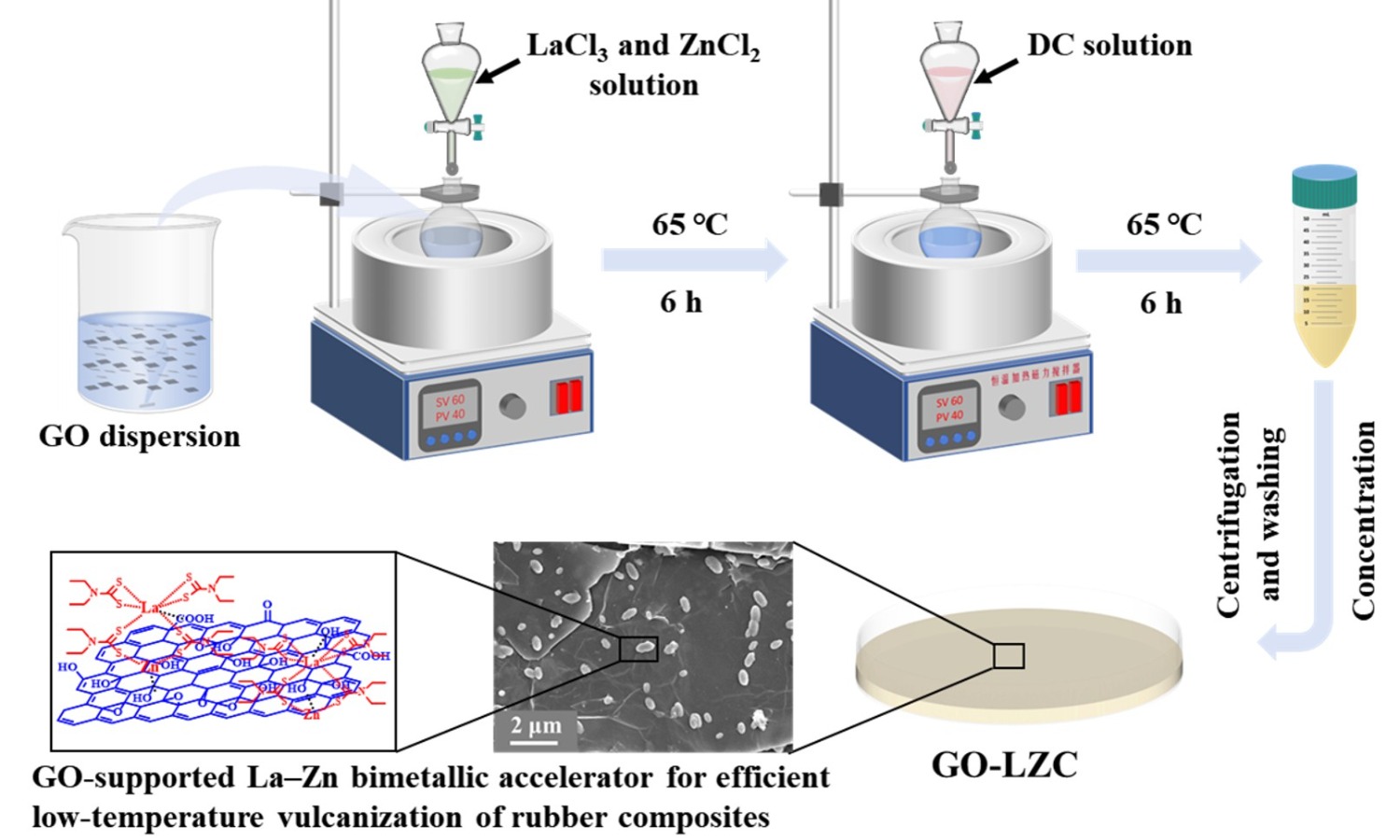
Conventional sulfur vulcanization in rubber manufacturing depends on elevated curing temperatures and zinc oxide activators, resulting in high energy consumption and increasing environmental concerns associated with zinc release. To overcome these limitations, a novel graphene oxide (GO)-supported rare-earth-containing accelerator (GO–LZC) was designed by coordinating lanthanum(III) and zinc(II) ions with sodium diethyldithiocarbamate (DC). At the same time, the oxygen-containing groups on GO further participated in ligand coordination. The resulting GO-immobilized complex exhibits a well-defined chelating structure and uniform nanoscale dispersion, which together enhance the accessibility and reactivity of active sulfurating species during curing. When incorporated into solution-polymerized styrene–butadiene rubber (SSBR), GO–LZC markedly promotes crosslink formation at reduced thermal input. Kinetic analysis reveals a substantial decrease in the apparent activation energy, and curing and mechanical tests confirm that efficient vulcanization can be achieved at 130 °C, representing a 20–40 °C reduction relative to typical industrial curing conditions. This work demonstrates a viable strategy for developing low-zinc, energy-efficient, and high-performance vulcanization systems. It highlights the potential of rare-earth/GO hybrid catalysts for sustainable rubber processing.
Péter Tamás-Bényei, Andrea Kohári, Ákos Görbe, Lóránt Kiss, Katalin Litauszki, Ferenc Szabó, László Mészáros, Károly Renner, Tamás Bárány
Vol. 20., No.6., Pages 547-550, 2026
DOI: 10.3144/expresspolymlett.2026.41
Vol. 20., No.6., Pages 547-550, 2026
DOI: 10.3144/expresspolymlett.2026.41
This is an editorial article. It has no abstract.
Junxiu Xue, Kaituo Fang, Zhenchun Xu, Huiguang Bian, Yu Wang, Yongming Zhang
Vol. 20., No.5., Pages 489-500, 2026
DOI: 10.3144/expresspolymlett.2026.37
Vol. 20., No.5., Pages 489-500, 2026
DOI: 10.3144/expresspolymlett.2026.37
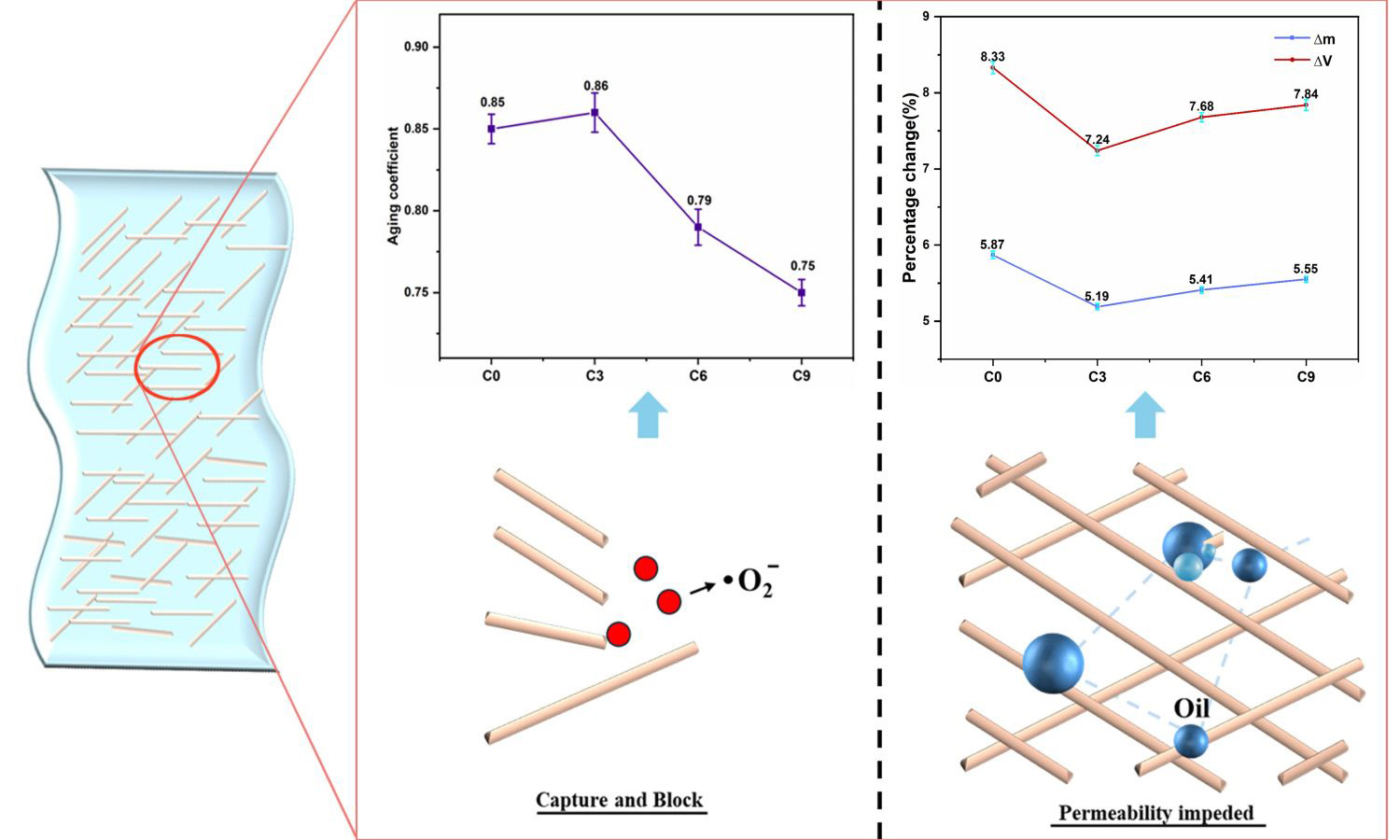
This study investigates the effects of renewable chopped cellulose fiber (CCleF) on the physical and mechanical properties, oil resistance, and thermal-oxidative aging behavior of acrylonitrile-butadiene rubber (NBR), aiming to determine the optimal filler content. CCleF/NBR composites with varying CCleF loadings were prepared and systematically characterized through analyses of vulcanization behavior, three-dimensional morphology, mechanical properties, thermal-oxidative aging, and oil resistance. The results indicate that the composite with 3 phr CCleF exhibits uniform fiber dispersion and optimal overall performance, showing enhanced processability, a reduced vulcanization time, and improved physical and mechanical properties. After thermal-oxygen aging, the composite demonstrated superior stability: the percentage change in tensile modulus, rebound resilience, and DIN abrasion decreased significantly by 13.73, 49.82, and 74.9%, respectively, while the aging coefficient reached 0.86. Notably, this composite also exhibited excellent oil resistance, with a volume expansion rate of 7.24%, which is 13.1% lower than that of unfilled NBR. Correspondingly, the tensile product’s retention rate decreased by 37.72%, while rebound resilience and abrasion resistance improved. This study demonstrates that incorporating 3 phr CCleF is a practical approach to achieving high-performance NBR, providing a material basis for its use in demanding environments such as the petrochemical industry.