
Effect of stacking layouts and water absorption on impact resistance of natural fabrics reinforced hybrid composites
Çiçek Özes , Tuba Alpyildiz, Hasan Onur Sağir, Serhat Göz
, Tuba Alpyildiz, Hasan Onur Sağir, Serhat GözVol. 20., No.4., Pages 395-413, 2026
DOI: 10.3144/expresspolymlett.2026.31
DOI: 10.3144/expresspolymlett.2026.31
Corresponding author: Çiçek Özes 
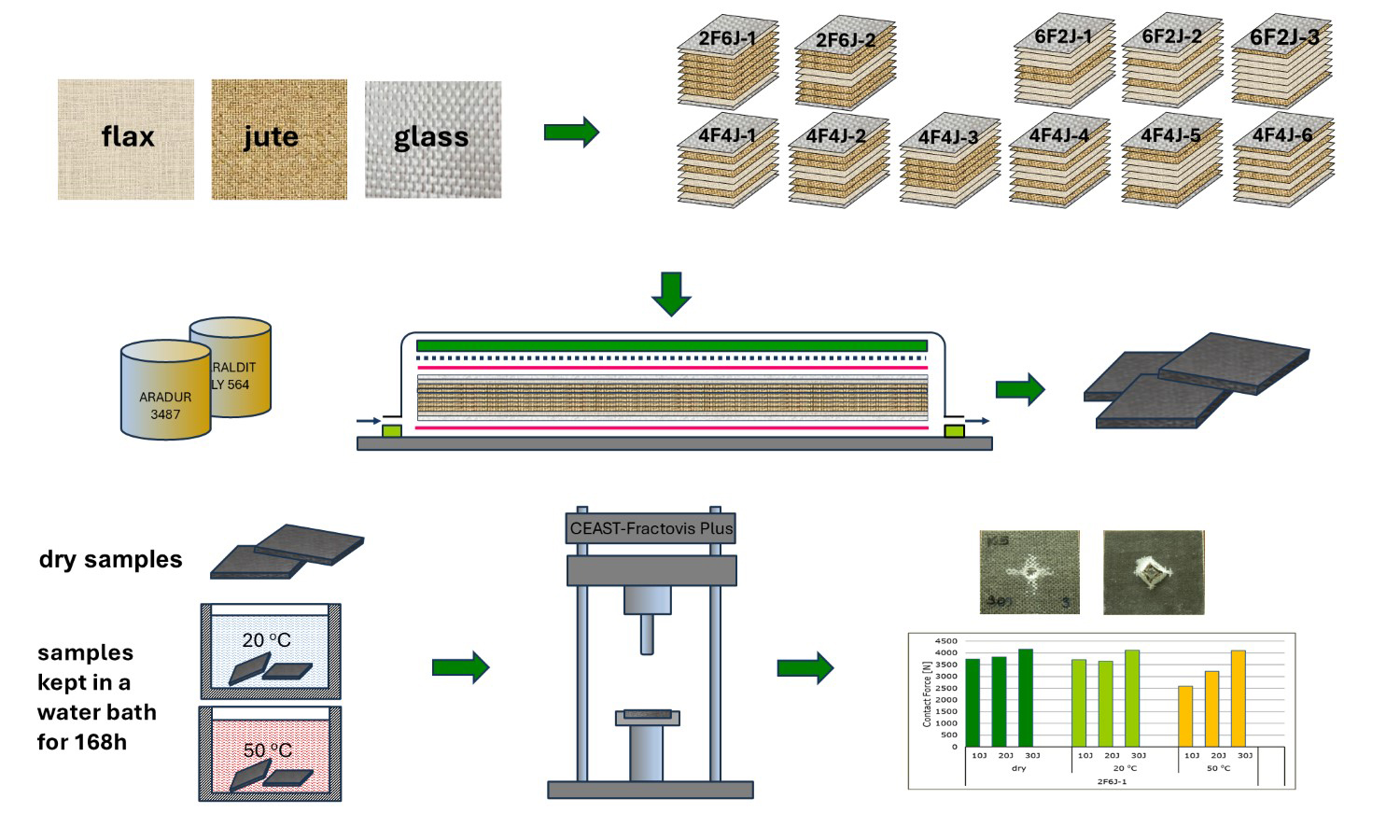
GRAPHICAL ABSTRACT
ABSTRACT
Natural fiber-reinforced composites, whose use is increasing daily in the building, automotive, and aerospace industries, are subjected to low-velocity impact loads in indoor applications. In most impact-exposed applications, increasing impact resistance through the hybrid use of different natural fibers is a frequently used solution. In this study, the impact resistance of hybrid composites reinforced with flax and jute fabrics was investigated in dry and water-absorbed conditions. The stacking layouts, the number of jute and flax fabric layers, and the type of fabric on the impact surface have been observed to affect the impact resistance of dry composites. Increasing the number of flax fabric layers increased water absorption. Although water absorption reduces the impact resistance of composites, it was also observed that impact damage is reduced at 20 J impact energy in some stacking layouts. The study results show that natural fiber-reinforced hybrid composites, produced with appropriate reinforcement elements and stacking layouts to enhance impact resistance, have the potential to increase their applicability in automotive and building sectors, where lightness and cost are key considerations.
RELATED ARTICLES
Noha Ramadan, Mohamed Taha, Ahmed Elsabbagh
Vol. 18., No.8., Pages 779-795, 2024
DOI: 10.3144/expresspolymlett.2024.58
Vol. 18., No.8., Pages 779-795, 2024
DOI: 10.3144/expresspolymlett.2024.58
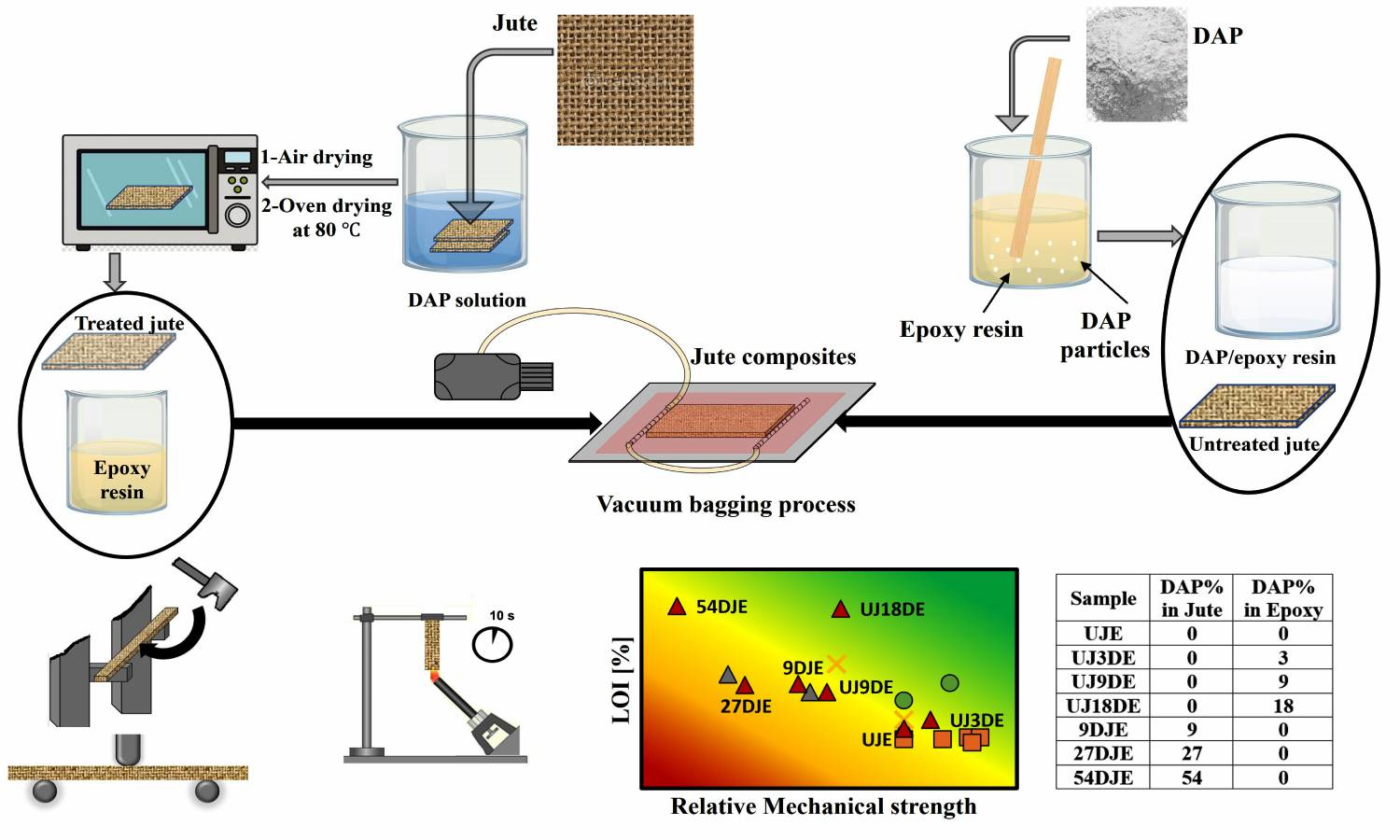
Natural fibre-reinforced polymer composite (NFRPC) has been introduced as one of the solutions to overcome the ecological and environmental problems accompanying the widespread usage of polymeric materials in every facet of life. However, the organic nature of both natural fibres (NFs) and polymers increases their flammability behaviour, and this, in turn, limits their application. In this regard, this work concentrates on studying the effect of adding flame retardants (FR) to jute-reinforced epoxy composites (JRECs), either by treating the jute fabric with diammonium phosphate (DAP) or adding DAP powder to the epoxy resin matrix on the flame retardancy performance as well as the mechanical properties. The results showed that the effect of the incorporation method of DAP either to jute fabric or to resin matrix has a significant difference on the flammability test results at low concentrations; however, at higher concentrations, the flame retardancy performance is not affected by the technique of adding FR to the composite system. On the other hand, the mechanical properties are significantly affected by the method of incorporating FR to JRECs at all concentrations. Moreover, the results obtained from JRECs with FR systems were evaluated and compared with the literature by constructing selection charts that relate the flame retardancy level to mechanical properties.