
Low-temperature supramolecular adhesives based on hyperbranched polyester
Yiting Jing, Sufang Chen, Zejun Xu , Tingcheng Li, Daohong Zhang
, Tingcheng Li, Daohong ZhangVol. 17., No.12., Pages 1200-1211, 2023
DOI: 10.3144/expresspolymlett.2023.91
DOI: 10.3144/expresspolymlett.2023.91
Corresponding author: Zejun Xu 
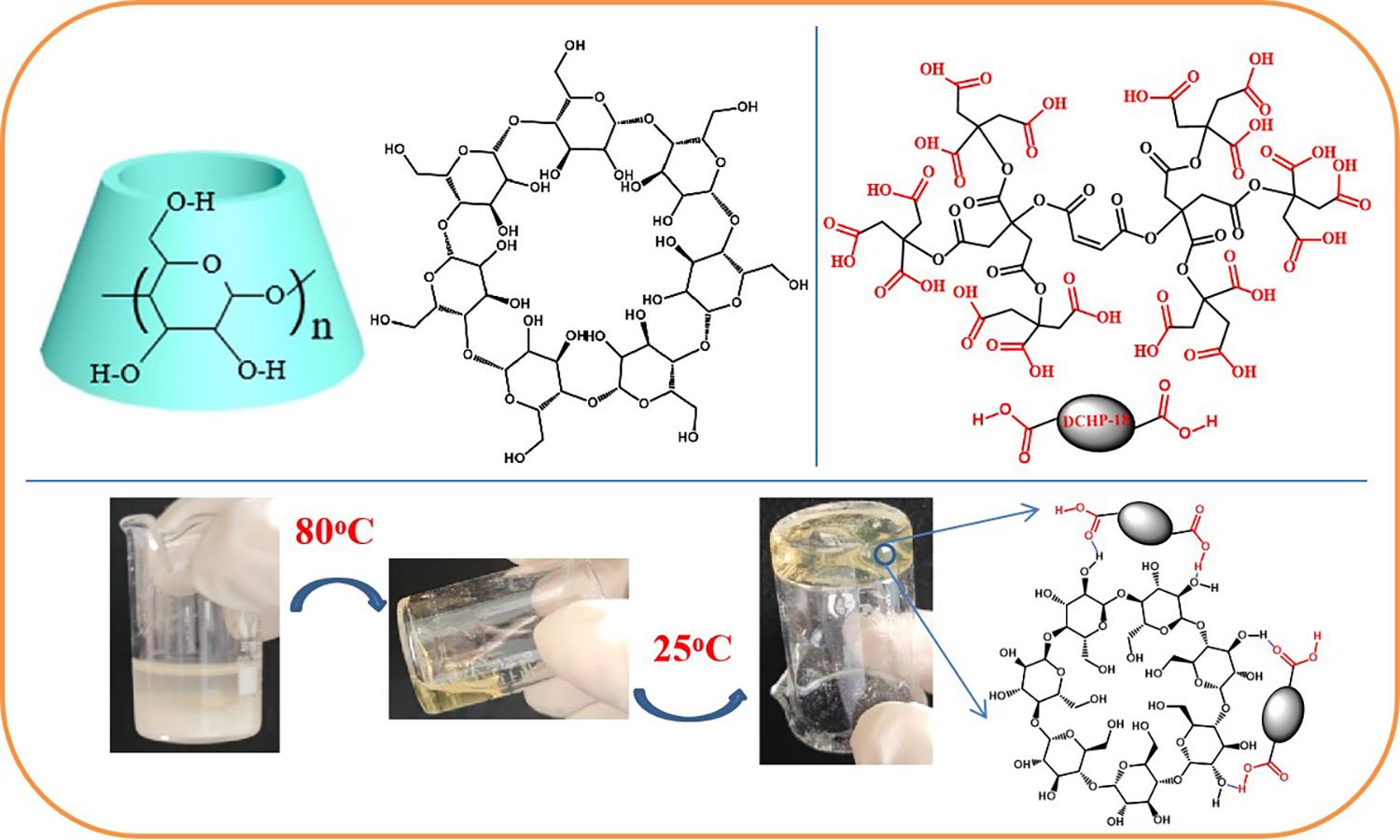
GRAPHICAL ABSTRACT
ABSTRACT
Adhesives have been widely applied in various fields. However, most industrial adhesives contain organic solvents, which are toxic and difficult to clean after use. Importantly, most adhesives are used in a relatively small temperature range (0–50 °C), which is due to the fragmentation of the morphology and properties of supramolecular polymer gels at low temperatures. Most of the supramolecular adhesives need to be heated during the bonding process, which cannot meet the requirements of low-temperature adhesion in daily life and industry. In this study, based on the concept of using deep eutectic solvents (DESs) as a platform, cyclodextrin (β-CD) and carboxyl terminated hyperbranched polyester (DCHP) were used to prepare solvent-free supramolecular polymer gel (CD-DCHP), which was non-toxic and easy to clean. Due to the joint action of deep eutectic solvent and supramolecular polymer structure, CD-DCHP showed excellent mechanical properties, super strong adhesion (up to 4.55 MPa on glass surface), and excellent low-temperature performance (up to 1.64 MPa at –60 °C). This supramolecular polymer gel also showed excellent tolerance to acids, alkalis, and various organic solvents. It greatly expanded the application of DES and provided a new approach to the development of supramolecular adhesives.
RELATED ARTICLES
Dániel Gere, Tamás Bárány
Vol. 19., No.6., Pages 554-555, 2025
DOI: 10.3144/expresspolymlett.2025.41
Vol. 19., No.6., Pages 554-555, 2025
DOI: 10.3144/expresspolymlett.2025.41
This is an editorial article. It has no abstract.
Ming Qiu Zhang
Vol. 18., No.6., Pages 559-560, 2024
DOI: 10.3144/expresspolymlett.2024.41
Vol. 18., No.6., Pages 559-560, 2024
DOI: 10.3144/expresspolymlett.2024.41
This is an editorial article. It has no abstract.