
Synthesis of carboxyl-functionalized poly(ethylene glycol)s via enzymatic catalysis
Aswathy Sasidharan Pillai, Peter Polyak , Gabor Kaszas, Judit E. Puskas
, Gabor Kaszas, Judit E. PuskasVol. 20., No.6., Pages 629-636, 2026
DOI: 10.3144/expresspolymlett.2026.47
DOI: 10.3144/expresspolymlett.2026.47
Corresponding author: Judit E. Puskas 
GRAPHICAL ABSTRACT
ABSTRACT
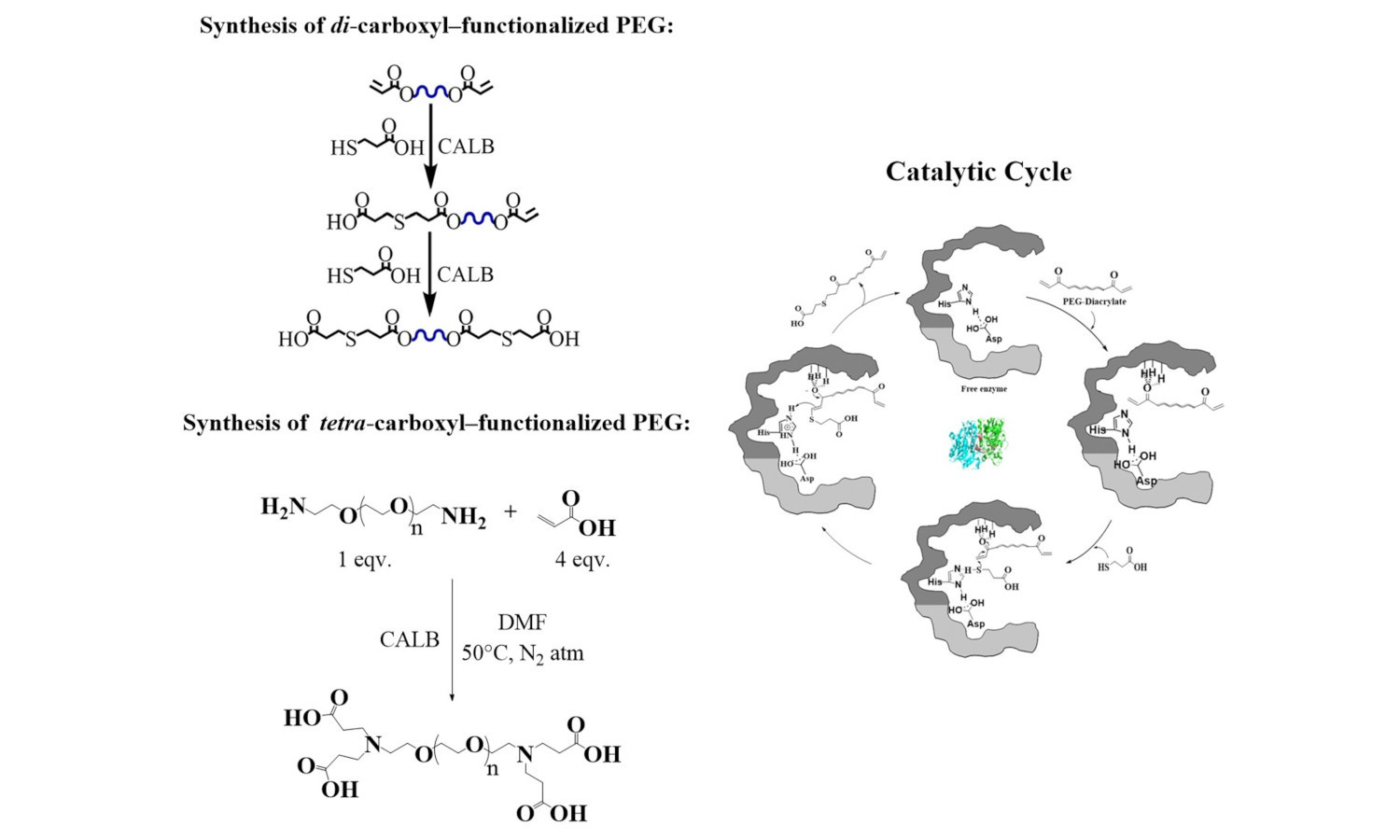
In this study, we present an effective chemo-enzymatic method for synthesizing di- and tetra-carboxyl–functionalized poly(ethylene glycol)s (PEGs) using Candida antarctica lipase B (CALB). PEG-diacid was synthesized through CALB-catalyzed Michael addition of 3-mercaptopropionic acid (3-MPA) to PEG-diacrylate. We found that the reactions proceeded in a stepwise manner, first producing monoacid. The synthesis of diacid required additional fresh CALB and 3-MPA. The structure of the products was confirmed by 800 MHz 1H NMR. PEG-tetraacid was synthesized in a single step via CALB-catalyzed Michael addition of acrylic acid to PEG-diamine. In both cases, the CALB-Catalyzed Michael addition reactions effectively produced carboxyl-functionalized PEGs.
RELATED ARTICLES
Konrad Stefaniak, Anna Masek
Vol. 19., No.4., Pages 386-408, 2025
DOI: 10.3144/expresspolymlett.2025.29
Vol. 19., No.4., Pages 386-408, 2025
DOI: 10.3144/expresspolymlett.2025.29
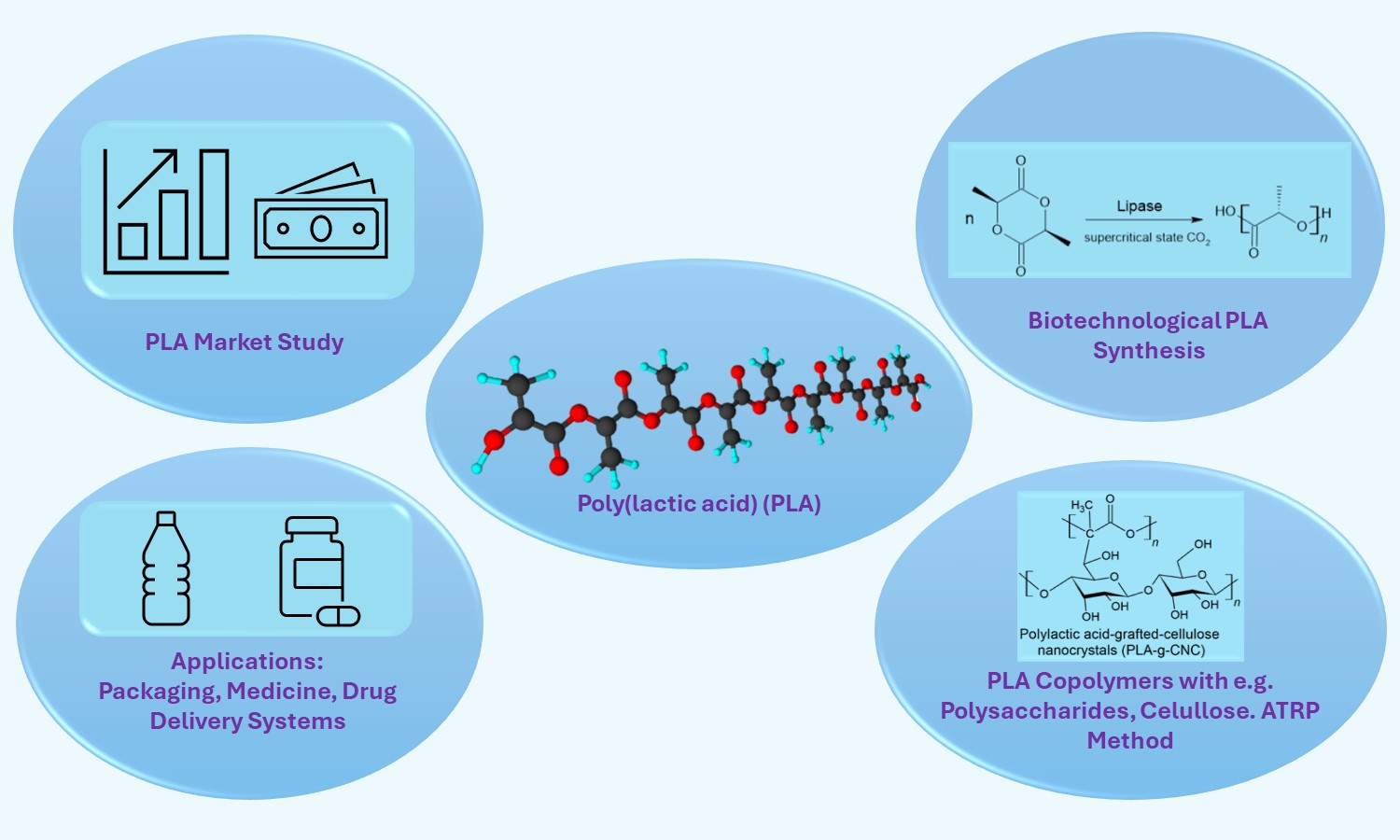
This review is focused on recent achievements in poly(lactic acid) (PLA) synthesis and copolymerization with special regard to biotechnological routes of PLA synthesis, which use bacteria/enzymes (e.g., enzymatic ring opening polymerization (eROP)). Besides PLA, also lactic acid (LA) synthesis is described and an emphasis is put on the biotechnological methods. Having regard to PLA copolymerization, this paper attempts to describe different types of PLA copolymers (such as block copolymers, PLA copolymers with polysaccharides, PLA-cellulose copolymer composites, and PLA polymer brushes). A detailed overview of the recent accomplishments in the field of PLA copolymers is presented. Various enhanced properties and applications of presented PLA copolymers are discussed. The attention is placed mainly on applications in the field of tissue engineering, drug delivery systems, and the packaging sector. Furthermore, a PLA market study and its economic forecast are presented. Eventually possible directions for future research in the field of PLA synthesis and copolymerization are indicated.