Bio-based aliphatic polyesters of 1,4-butanediol with different diacids: Effect of carbon chain lengths on mechanical properties and enzymatic hydrolysis
Shuning Liu, Xinru Cheng, Tingting Su, Zhanyong Wang
Vol. 18., No.12., Pages 1209-1223, 2024
DOI: 10.3144/expresspolymlett.2024.92
DOI: 10.3144/expresspolymlett.2024.92
Corresponding author: Tingting Su 
GRAPHICAL ABSTRACT

ABSTRACT
Polybutylene succinate, polybutylene adipate, polybutylene suberate and their copolyesters were synthesized. The physical properties and biodegradability of these polyesters were controlled by adjusting the composition of carboxyl monomers. Compared with the homopolyesters, the addition of comonomer during polymerization resulted in the formation of copolyesters with lower melting temperatures and crystallinity. Among them, poly(butylene succinate-co-adipate) (PBSA) had the lowest crystallinity, and poly(butylene adipate-co-suberate) (PBASub) had the lowest melting point. The elongation at break and tensile strength of PBSA was 766.2% and 21.5 MPa, respectively. Enzymatic degradation by Fusarium solani cutinase (FsC) showed that both the crystalline and amorphous regions of the polyester were simultaneously degraded by FsC, and the crystal structure of the polyester was not disrupted. FsC preferentially got attached to the surface of polyesters, subsequently attacked the center of the films, and the water penetrated the amorphous region, leading to enhanced enzymatic hydrolysis. The biodegradability of copolyester was higher than that of homopolyesters. PBSA and poly(butylene succinate-co-suberate) (PBSSub) were completely degraded in about 10 h, and can be used in agricultural, automotive, electronics, biomedical materials, packaging, etc.
RELATED ARTICLES
Elena Pikurova, Anatoly Boyandin, Anna Sukhanova, Eugenia Raldugina, Semyon Fesik, Alexandra Mechenis
Vol. 20., No.10., Pages 1053-1071, 2026
DOI: 10.3144/expresspolymlett.2026.77
Vol. 20., No.10., Pages 1053-1071, 2026
DOI: 10.3144/expresspolymlett.2026.77
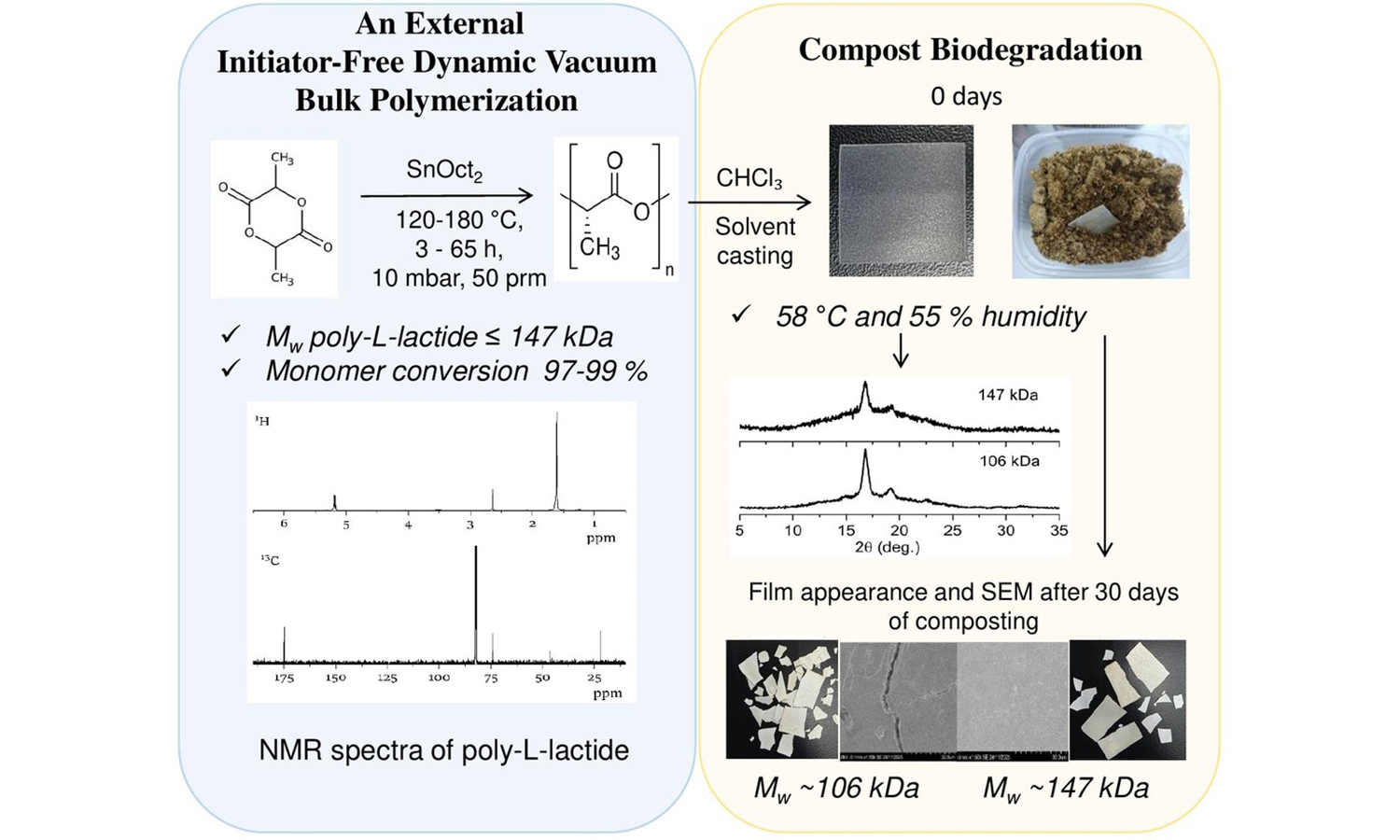
We successfully synthesized poly-L-lactide was via an advanced external initiator-free dynamic vacuum bulk polymerization technique, and achieved precise control of macromolecular weight up to 147 kDa with near-quantitative monomer conversion by varying reaction temperature and duration. Nuclear magnetic resonance spectroscopy confirmed that the stereoregular structure is predominantly preserved during the high-temperature synthesis, while any potential racemization pathways remain beneath the resolution limit of the analytical methods. Thermal analysis verified excellent polymer stability above 300 °C. To evaluate practical applicability, we fabricated solvent-cast films from the synthesized matrices. The tensile test results of the solvent-cast films showed that while the amorphous 147 kDa matrix reached a tensile strength of 28.0 MPa, the structurally optimized 106 kDa film had higher crystallinity (20.6%) and a maximum Young’s modulus of 3047 MPa. Finally, compost biodegradation experiments (58 °C, 55% moisture content) demonstrated that decreasing molecular weight from 147 to 66 kDa accelerates the disintegration rate of films from k = 0.0041 to 0.0083 day–1 due to autocatalytic carboxyl end-groups and defective interspherulitic boundaries.
Malgorzata Latos-Brozio, Aleksandra Drzazga, Anna Masek, Zdzisława Mrozińska, Marcin H. Kudzin
Vol. 20., No.7., Pages 742-760, 2026
DOI: 10.3144/expresspolymlett.2026.56
Vol. 20., No.7., Pages 742-760, 2026
DOI: 10.3144/expresspolymlett.2026.56
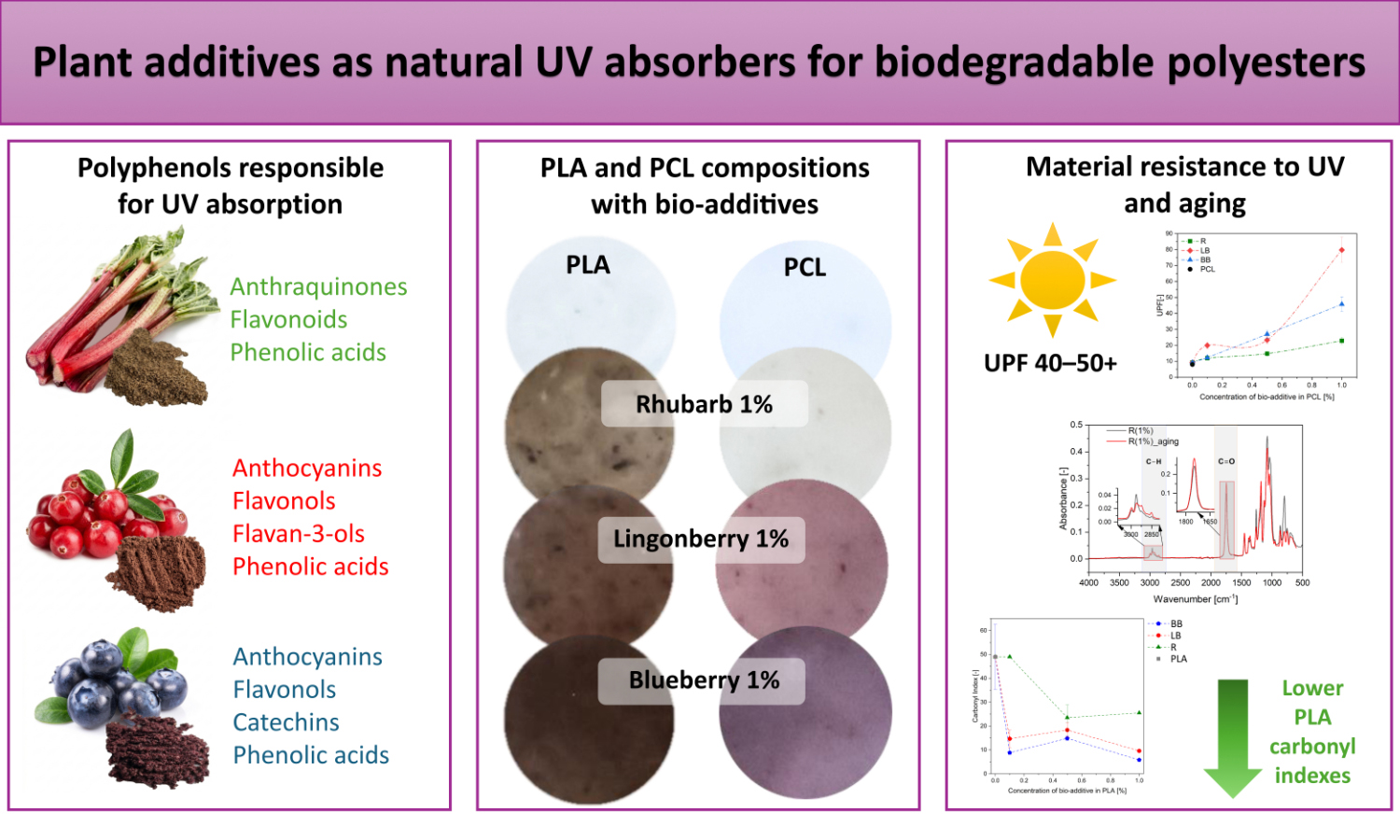
We investigated the effectiveness of plant-based bio-additives – rhubarb, lingonberry, and blueberry (0.1–1%) – as natural UV absorbers in biodegradable polymers polylactide (PLA) and polycaprolactone (PCL). A novelty of this work is the direct use of plant-based raw materials as UV absorbers in polymers. We performed Fourier transformed infrared spectroscopy (FT-IR) and UV-Vis analysis of the bio-additives, determined the ultraviolet protection factor (UPF) for the polymer samples, and evaluated their physicochemical properties (structural changes, colour, hardness, surface energy) after weathering (PLA) and thermo-oxidative (PCL) aging. Spectroscopic tests confirmed the presence of UV-A/UV-B-absorbing chromophores in the additives. Samples with 1% berries had excellent UV protection (UPF 40–50+), while PLA and PCL containing 1% rhubarb had lower UPF values (around 22), indicating good UV blocking properties. After aging, PLA-containing berries showed a significantly lower carbonyl index (CI), indicating reduced photodegradation. For PCL with lingonberry, this additive gave the greatest reduction in thermo-oxidative degradation (lowest CI). All plant additives increased material hardness by acting as nucleating agents; they increased the crystallinity of polyester, and aging further strengthened this effect. Bio-additives, especially berries, can increase the hardness and UV resistance of polymers and limit material aging. These polymer compositions are suitable for packaging materials.
Evangelia Balla, Panagiotis Klonos, Apostolos Kyritsis, Dimitrios Bikiaris
Vol. 20., No.2., Pages 154-167, 2026
DOI: 10.3144/expresspolymlett.2026.13
Vol. 20., No.2., Pages 154-167, 2026
DOI: 10.3144/expresspolymlett.2026.13
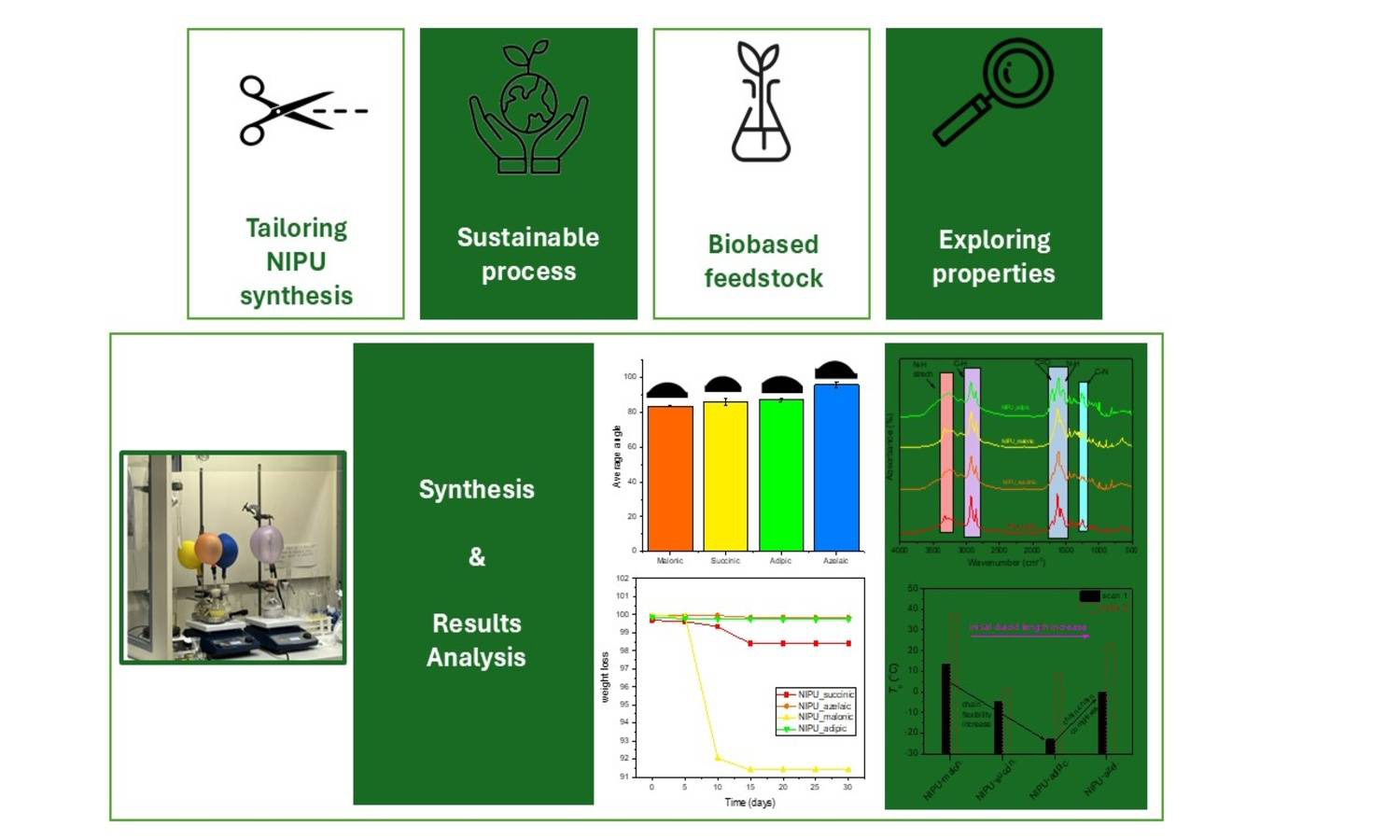
In recent decades, numerous efforts have been dedicated to the investigation of eco-friendly non-isocyanate polyurethanes (NIPUs) as alternatives to conventional polyurethanes (PUs). Since isocyanates are classified by the EU as hazardous and toxic compounds, NIPUs offer a promising route to mitigate isocyanate-related health risks as well as other environmental concerns associated with traditional PU synthesis. In the present study, we report the synthesis as well as the detailed structural and thermal characterization of a new series of fully biobased non-isocyanate polyurethanes (NIPUs) based on aliphatic dicarboxylic acids of different chain lengths. The NIPUs were prepared via a two-step polyaddition reaction involving glycerol carbonate and diamine. Their synthesis enables a sustainable pathway to tailor NIPUs’ physicochemical properties via diacid structure control. Studies of their structure, thermal behavior and trends, morphological, and hydrolytic findings confirmed strong diacid chain length dependence on glass transition temperature (Tg ~13, 0, ‒5 and –23 °C), molecular weight, surface wettability, and enzymatic degradability. Short-chain diacids yielded NIPUs with rapid hydrolytic degradation, while their longer-chain analogs were hydrophobic and thermally stable. Contact angle measurements (~75–85°) also confirm these trends. The tunable properties position these materials among strong candidates for biomedical applications.
Mpho Phillip Motloung, Mokgaotsa Jonas Mochane
Vol. 19., No.11., Pages 1092-1132, 2025
DOI: 10.3144/expresspolymlett.2025.82
Vol. 19., No.11., Pages 1092-1132, 2025
DOI: 10.3144/expresspolymlett.2025.82
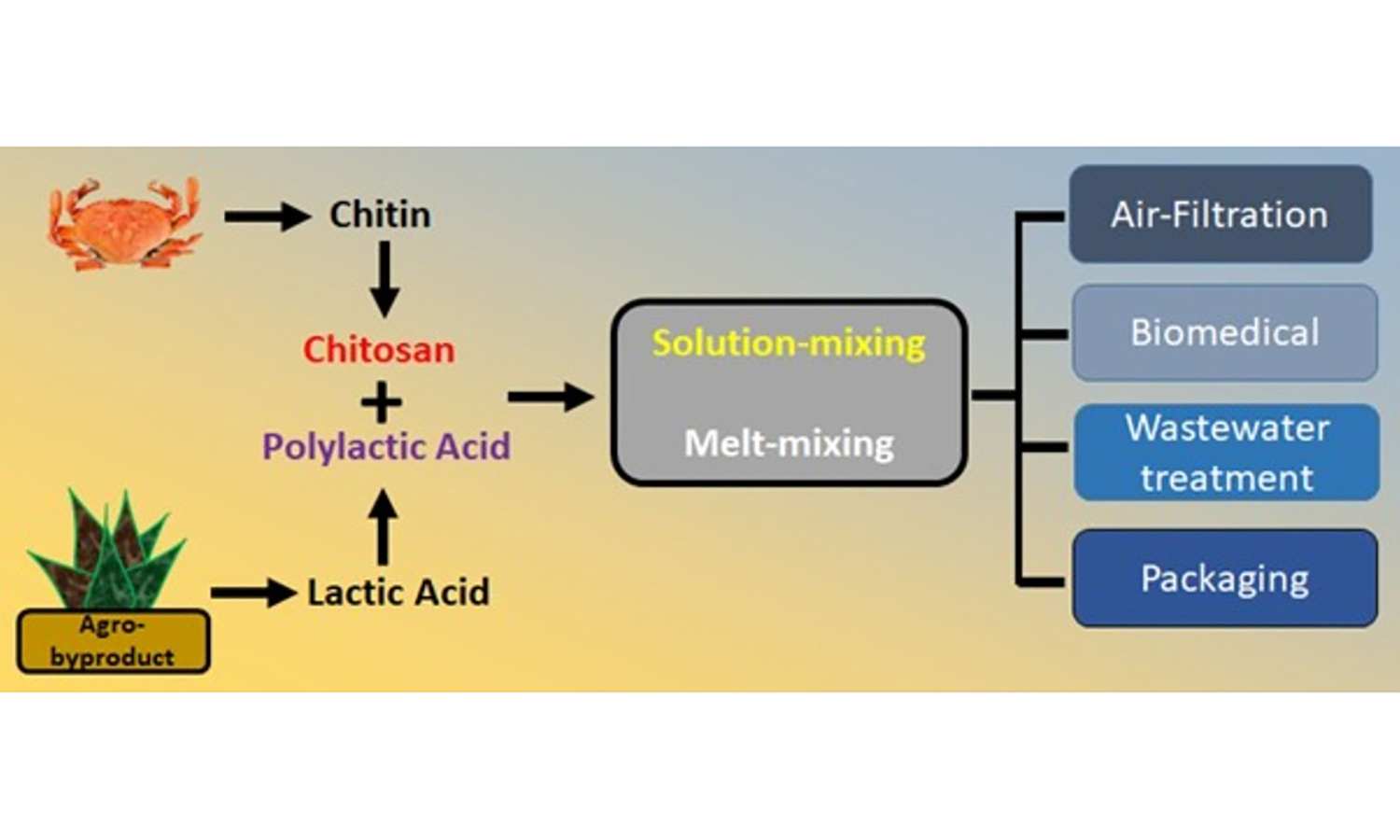
Polylactic acid (PLA) is one of the most widely used biopolymers, and it has demonstrated a huge potential for replacing some of the conventional plastics in certain application fields. However, due to a lack of other attributes such as antimicrobial properties and slow degradation rates, it is often blended with other polymers to impart these properties. Chitosan has desirable features including antimicrobial and antioxidant properties, biodegradability and biocompatibility, and environmental friendliness. Thus, it is widely blended with PLA to generate materials that can be applied in various fields. In recent years, PLA/chitosan blend composites and nanocomposites have been produced to develop sustainable and ecofriendly materials that can be suitable in active food packaging, water treatment, air filtration, and biomedical applications. This review provides an overview of the recent advancements in the development of PLA/chitosan blend composites and nanocomposites for various applications. The processing strategies, mechanical and thermal properties, together with utilization in biomedical, air filtration, water treatment, and packaging applications, are provided.
Katalin Litauszki, Tamás Tábi, László Mészáros
Vol. 19., No.5., Pages 455-456, 2025
DOI: 10.3144/expresspolymlett.2025.33
Vol. 19., No.5., Pages 455-456, 2025
DOI: 10.3144/expresspolymlett.2025.33
This is an editorial article. It has no abstract.