Antibacterial chitosan-reinforced poly(vinyl alcohol) fibers produced via wet-spinning: Structural, thermal, mechanical, and antimicrobial properties relevant for biomedical use
Khmais Zdiri, Aurélie Cayla, Christine Campagne
Vol. 20., No.4., Pages 383-394, 2026
DOI: 10.3144/expresspolymlett.2026.30
DOI: 10.3144/expresspolymlett.2026.30
Corresponding author: Khmais Zdiri 
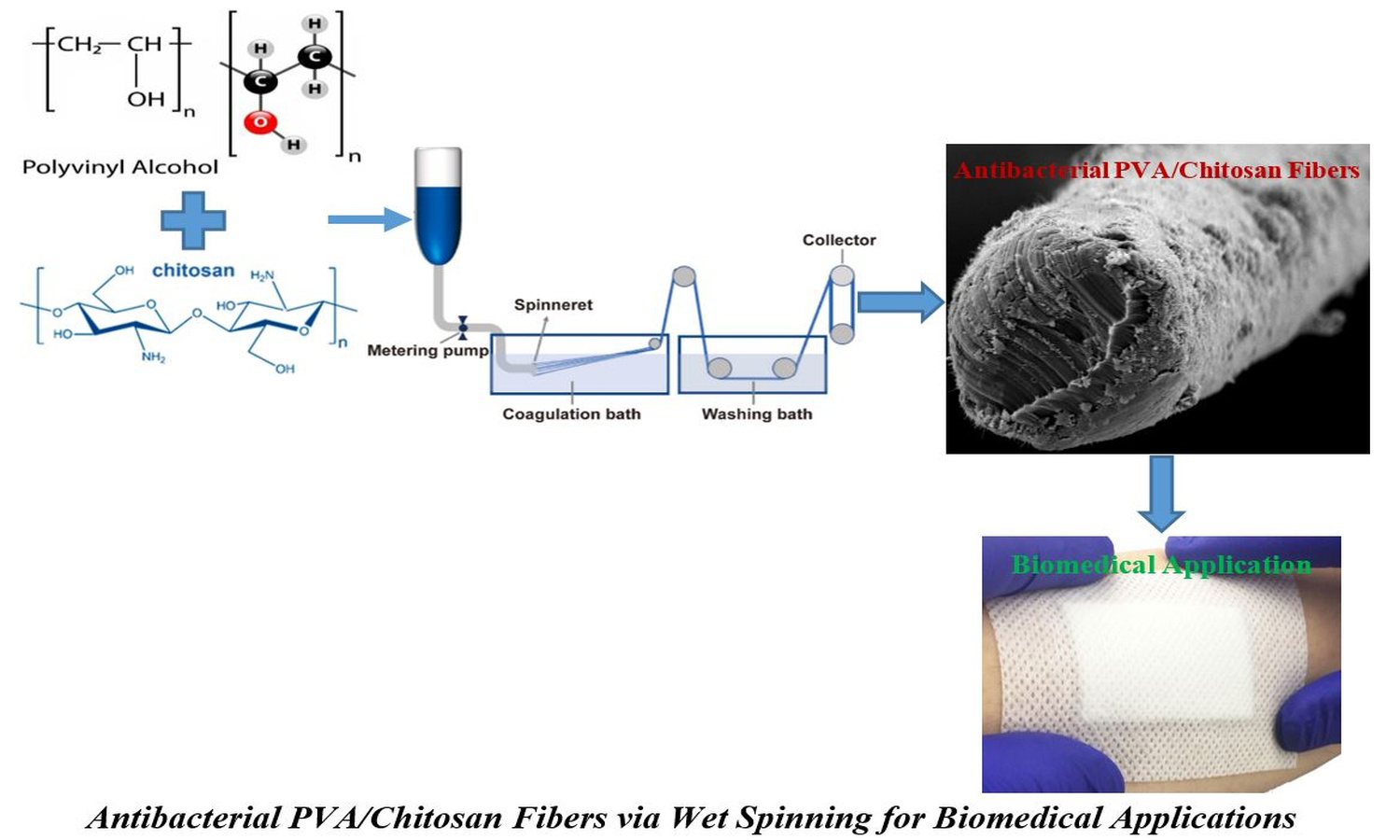
GRAPHICAL ABSTRACT
ABSTRACT
Growing interest in natural and eco-friendly materials has driven the search for sustainable alternatives to synthetic antimicrobial agents. This study aims to develop antibacterial fibers based on poly(vinyl alcohol) (PVA) reinforced with chitosan (CTS) using an environmentally friendly wet-spinning process. Morphological analysis revealed surface irregularities that increased with CTS content, confirming its effect on fiber microstructure. Thermal analyses by differential scanning calorimetry (DSC) and thermogravimetric analysis (TGA) showed that CTS incorporation decreased the melting temperature while improving thermal stability. Mechanical testing demonstrated enhanced tensile strength (σs) and Young’s modulus (E) due to strong intermolecular interactions between CTS and the PVA matrix. The highest σs (1045 MPa) was obtained at 3 wt% CTS, while E reached 7.1 GPa at 5 wt%. Antibacterial tests against Staphylococcus aureus and Escherichia coli confirmed strong activity attributed to –NH2 groups of CTS disrupting bacterial membranes. These results highlight the potential of PVA/CTS fibers for biomedical applications such as wound dressing and antibacterial materials.
RELATED ARTICLES
Widtawad Reantong, Siriluk Chiarakorn, Muthita Vanaporn, Natee Srisawat
Vol. 19., No.12., Pages 1256-1273, 2025
DOI: 10.3144/expresspolymlett.2025.93
Vol. 19., No.12., Pages 1256-1273, 2025
DOI: 10.3144/expresspolymlett.2025.93

The development of functional antibacterial spunbond fabrics is critical for improving indoor environmental treatment. This study presents the fabrication of polypropylene (PP) fibers embedded with silane-modified Zr/Ag co-doped TiO2 nanoparticles. The Zr (5 mol%) and Ag (3 mol%) co-doped TiO2 nanoparticles were synthesized via a solvothermal method and subsequently modified with 5 wt% hexadecyltrimethoxysilane (HDTMS), referred to as ZATS5. The solvothermal method enables the controlled synthesis of phase-pure, well-dispersed nanostructures and facilitates dopant incorporation in the photocatalysts completely. Additionally, HDTMS surface modification improved compatibility with the polypropylene matrix, enhancing dispersion and interfacial bonding and improving overall composite performance. ZATS5 was incorporated into the PP matrix through melt spinning to produce composite fibers. The minimum of ZATS5 at 1 wt% embedded in spunbond nonwoven composite (PP/ZATS5-1) demonstrated the fiber’s structural integrity and remarkable antibacterial activity. The PP/ZATS5-1 nonwoven fabric achieved 99.98% inactivation of Legionella pneumophila under dark conditions and complete inhibition under visible light. This research offers a scalable and effective strategy for developing antibacterial spunbond nonwoven fabrics with potential applications in medical textiles, as well as air and water purification systems operating under ambient indoor lighting.
Jutatip Makmanee Treitler, Diew Saijun, Kritsada Phatcharasit, Suwat Rattanapan
Vol. 19., No.12., Pages 1310-1319, 2025
DOI: 10.3144/expresspolymlett.2025.96
Vol. 19., No.12., Pages 1310-1319, 2025
DOI: 10.3144/expresspolymlett.2025.96
This work introduces an innovative method to enhance the compatibility of nylon-12/natural rubber thermoplastic elastomers by utilizing hydroxyl telechelic natural rubber as a reactive compatibilizer and natural fibers as reinforcement. Hydroxyl telechelic natural rubber was synthesized from natural rubber via oxidative cleavage to carbonyl telechelic natural rubber, followed by reduction with sodium borohydride. Proton nuclear magnetic resonance (1H-NMR) and Fourier transform infrared spectroscopy (FTIR) verified the structure. Incorporating hydroxyl telechelic natural rubber into nylon-12/natural rubber (40/60 wt%) blends significantly enhanced interfacial adhesion, improving tensile strength and elongation at break compared to the uncompatibilized mix. Dynamic vulcanization using phenolic resin achieved an optimal balance of strength and ductility. The incorporation of areca husk fiber enhanced tensile strength, hardness, and solvent resistance, with a slight decrease in ductility and tear strength. Rheological analysis indicated that hydroxyl telechelic natural rubber increased melt viscosity due to improved phase interactions, while dynamic vulcanization reduced the melt flow index through network formation. Solvent uptake experiments confirmed that hydroxyl telechelic natural rubber, areca husk fiber, and SP-1045 vulcanizing agent minimized swelling in isooctane, toluene, and diesel oil.
Sarahí Bautista Reberte, Esmeralda Zuñiga Aguilar, Solange Ivette Rivera Manrique, Carlos Alberto Martínez-Pérez
Vol. 19., No.3., Pages 326-338, 2025
DOI: 10.3144/expresspolymlett.2025.23
Vol. 19., No.3., Pages 326-338, 2025
DOI: 10.3144/expresspolymlett.2025.23
Three-dimensional (3D) bioprinting is a technique currently used for creating tissue engineering scaffolds, using bioinks as the building blocks. These bioinks are composed of biomaterials that provide structural integrity and are synthesized from organic polymers to enhance biocompatibility with the printed constructs. In this study, a series of eleven chitosan-based bioinks were synthesized using the sol-gel technique, employing chitosan of low and medium molecular weight. Three bioink formulations were selected based on their viscosity characteristics and further enriched with gelatin and hydroxyapatite (HA) to enhance their mechanical properties. Characterization tests included Fourier-transform infrared spectroscopy (FTIR), thermogravimetric analysis (TGA), scanning electron microscopy (SEM), and rheological assessments. Viscoelastic materials were obtained, and an experimental model was developed to optimize printing parameters, focusing on pressure and printing speed. Our findings indicate that a bioink formulation comprising a blend of medium and high molecular weight chitosan, supplemented with gelatin and hydroxyapatite, was found to be a promising approach for fabricating scaffolds for bone tissue repair.
Konstantin Vadimovich Malafeev, Olga Andreevna Moskalyuk, Vladimir Evgenyevich Yudin, Dmitry Nikolayevich Suslov, Elena Nikolaevna Popova, Elena Mikhaylovna Ivan’kova, Alena Alexandrovna Popova
Vol. 18., No.3., Pages 296-308, 2024
DOI: 10.3144/expresspolymlett.2024.21
Vol. 18., No.3., Pages 296-308, 2024
DOI: 10.3144/expresspolymlett.2024.21
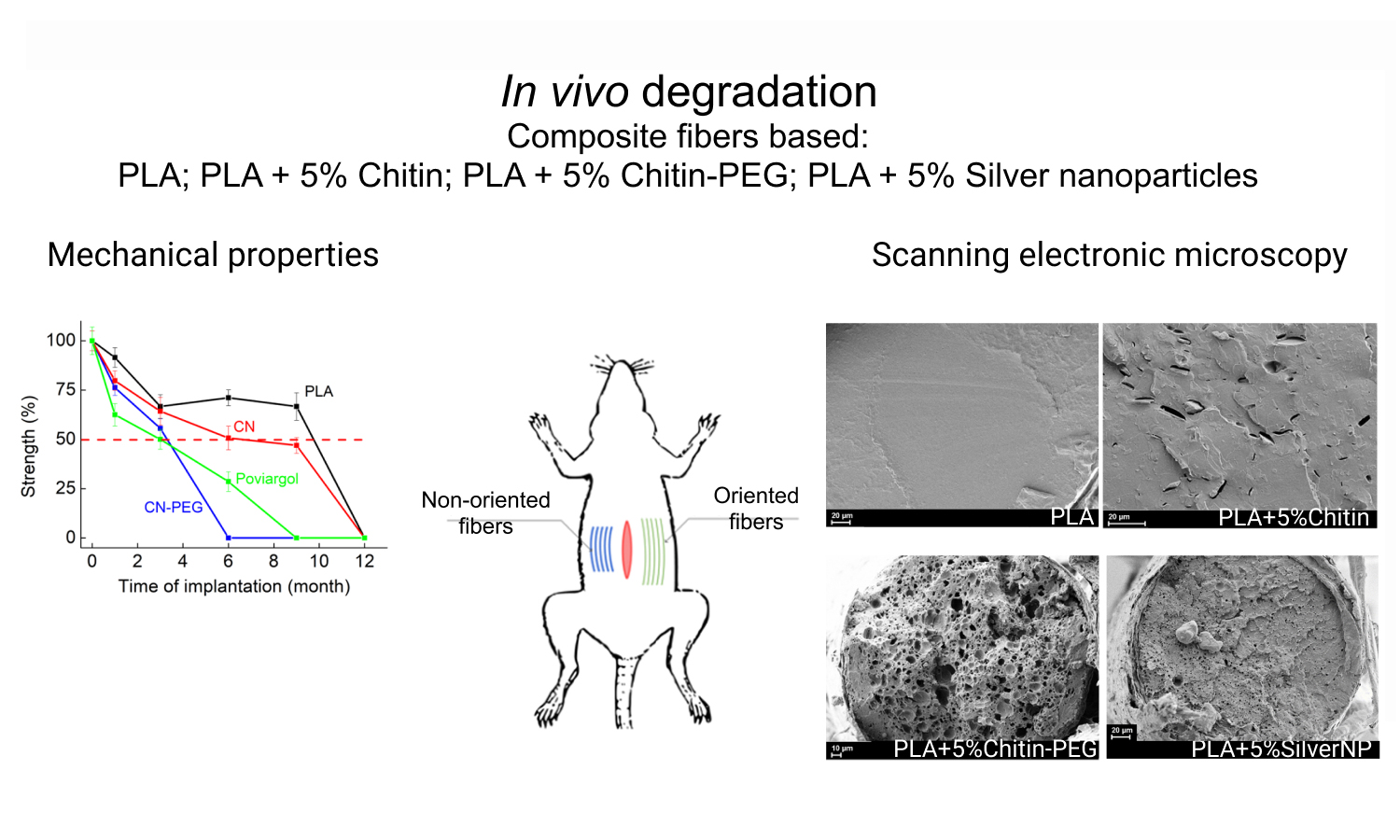
The rates of in vivo bioresorption of composite monofilaments based on polylactide (PLA) containing chitin nanofibrils of two types (pure chitin (CN) or chitin modified with poly(ethylene glycol) (CN-PEG)) or silver nanoparticles stabilized with poly(N-vinylpyrrolidone) (Poviargol) were studied. The in vivo bioresorption rate and its dependence on the degree of orientational drawing of the samples (which varied from 1 in non-oriented samples to 4 in oriented samples) were investigated up to 12 months after implantation. Bioresorption of the samples was monitored using differential scanning calorimetry, scanning electron microscopy, and mechanical tests. Using the differential scanning calorimetry (DSC) method, it was shown that there is a gradual decrease in molecular weight due to a decrease in the temperatures of phase transitions and changes in peak shapes. It has also been shown that the addition of fillers containing water-soluble polymers accelerates the bioresorption of composite sutures. A thread made from pure PLA lost half its strength by the 9th month of implantation, whereas for threads with the addition of CNPEG or Poviargol, this happened after 3.5 months. This causes leaching of water-soluble agents and changes in the supramolecular structure of the filament. This study shows the promise of using these composite threads as a suture material.